Table of contents
Liège-Bastogne-Liège is not just another classic
Liège-Bastogne-Liège is not just another classic. It is La Doyenne, the oldest race in the current professional calendar, first held in 1892. That is not just a historical detail. It also explains part of its identity. This is a race that was not designed for modern cycling, but has evolved with it while keeping a demanding, irregular and difficult-to-control course.
Even though it takes place in Belgium, it has very little in common with the Tour of Flanders. Belgium is a small country, but from a cycling point of view it is highly diverse. Flanders and Wallonia, where the Ardennes are located, present very different profiles. In Flanders, the race is defined by short, explosive climbs, often on cobbles, where absolute power, positioning and the ability to produce very high power spikes matter more. In the Ardennes, by contrast, the climbs are longer, steadier and less technical, where body weight and watts per kilo play a much bigger role, and positioning is usually less decisive because of the wider roads.
That is why trying to interpret Liège with the logic of Flanders is a mistake. They are two different types of races even if they belong to the same country.
Liège as a very long one-day medium mountain stage
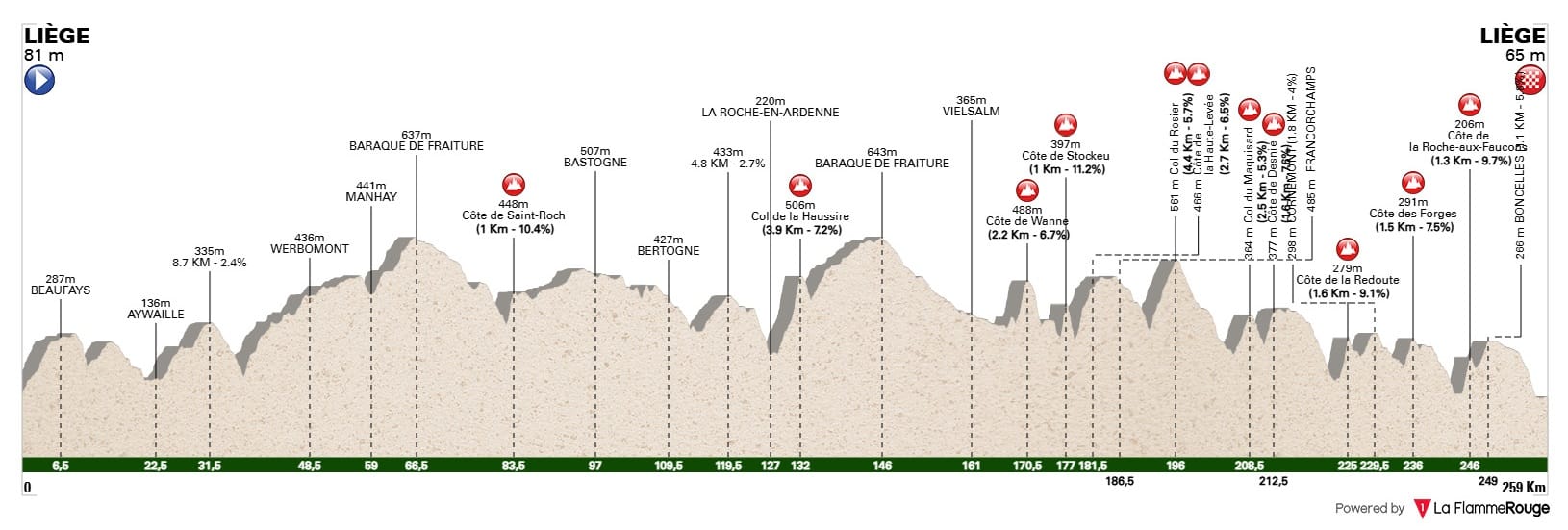
More than a classic of short, steep walls, Liège is better understood as a medium mountain stage compressed into a single day: more than 250 km and around 4,300 m of elevation gain. We call it a medium mountain stage because of the density of climbing, not because 4,300 m is a small figure. In fact, it is a very serious number. The difference lies in how that difficulty is distributed across the route.
It is not pure high mountain racing, but neither is it a cobbled classic. It sits somewhere between Il Lombardia and the Tour of Flanders. It is a race where accumulated fatigue and the ability to keep producing watts late in the day make the difference, just as in the other monuments.
Liège’s distance and elevation in context
If we compare Liège with other hard races and mountain stages, one idea becomes clear: the issue is not only the absolute elevation gain, but how it is distributed and in what context it appears.
| Race / stage | Edition | Distance | Elevation gain | Time | Average speed | Elevation density |
|---|---|---|---|---|---|---|
| Tour 2026 stage 20 | 2026 | 171 km | 5,600 m | ~5h10′ | ~33 km/h | 6.55 |
| Tour 2022 stage 12 | 2022 | 165.1 km | 4,660 m | 4h55’24” | 33.534 km/h | 5.65 |
| Il Lombardia | 2025 | 241 km | 4,800 m | 5h45’53” | ~41.8 km/h | 3.98 |
| Liège-Bastogne-Liège | 2025 | 252 km | 4,365 m | 6h00’09” | 41.983 km/h | 3.46 |
| Milano-Sanremo | 2026 | 298 km | 2,545 m | 6h35’49” | 45.172 km/h | 1.71 |
| Tour of Flanders | 2026 | 268.9 km | 2,007 m | 6h20’07” | 42.445 km/h | 1.49 |
| Paris-Roubaix | 2026 | 258.3 km | 1,375 m | 5h16’52” | 48.910 km/h | 1.06 |
The numbers tell a story that a simplified profile does not always show clearly. And that story is the following: in terms of density, Liège does not reach the levels of the hardest high mountain stages, but it does sit clearly above most monuments in terms of relative vertical difficulty. Even so, in absolute elevation gain, because it is such a long race, it still reaches figures comparable to a mountain stage in a Grand Tour. That much climbing takes its toll over the course of the day.
Elevation density is a useful way to interpret these data. It is a simulation of what the average gradient would be if the entire race were one continuous climb and one continuous descent. In practice, it helps explain how concentrated the difficulty is in relation to the total distance.
This is key to interpreting a route correctly. Riding 200 km with 2,000 m of climbing is usually considered relatively flat terrain. Doing those same 2,000 m in 70 or 80 km means a much higher density and already starts to resemble a high mountain stage. So elevation density does not only measure how much climbing there is, but how concentrated that effort is, which is what really determines the type of race.
The climbs and the false story told by total elevation
One detail that is almost never mentioned is that the 11 main climbs add up to approximately 1,707 metres of elevation gain. That means less than half of the total elevation comes from the categorized climbs. The rest, more than 2,600 metres, accumulates through rolling terrain, false flats and unnamed rises that never appear in the official summaries.
This figure, which is an estimate based on the length and gradient of each climb rather than an official number, has an important practical implication: Liège is much more wearing than any simplified profile suggests. It is not that the climbs are harder than they look. It is that between one climb and the next, the race never truly lets up. And over 250 kilometres, that changes the nature of the effort completely.
Climb analysis
Fatigue-building climbs
- Saint-Roch — 1.0 km at 11.2%. KOM: 2:23.
- Haussire — 3.9 km at 6.8%. KOM: 11:03.
- Mont-le-Soie — 1.7 km at 7.9%. KOM: 3:54.
These climbs add fatigue, but they rarely decide the race.
Selection climbs
- Wanne — 3.6 km at 5.1%. KOM: 6:49.
- Stockeu — 1.0 km at 12.5%. KOM: 3:03.
- Haute-Levée — 2.2 km at 7.5%. KOM: 6:49.
- Rosier — 4.4 km at 5.9%. KOM: 9:49.
This is where the group starts to break apart. The less resilient riders begin to disappear.
Race-deciding climbs
- Desnié — 1.6 km at 8.1%. KOM: 4:19.
- La Redoute — 1.6 km at 9.4%. KOM: 4:01.
- Forges — 1.3 km at 7.8%. KOM: 1:42.
- Roche-aux-Faucons — 1.3 km at 11%. KOM: 3:31.
This final block is what defines the race.
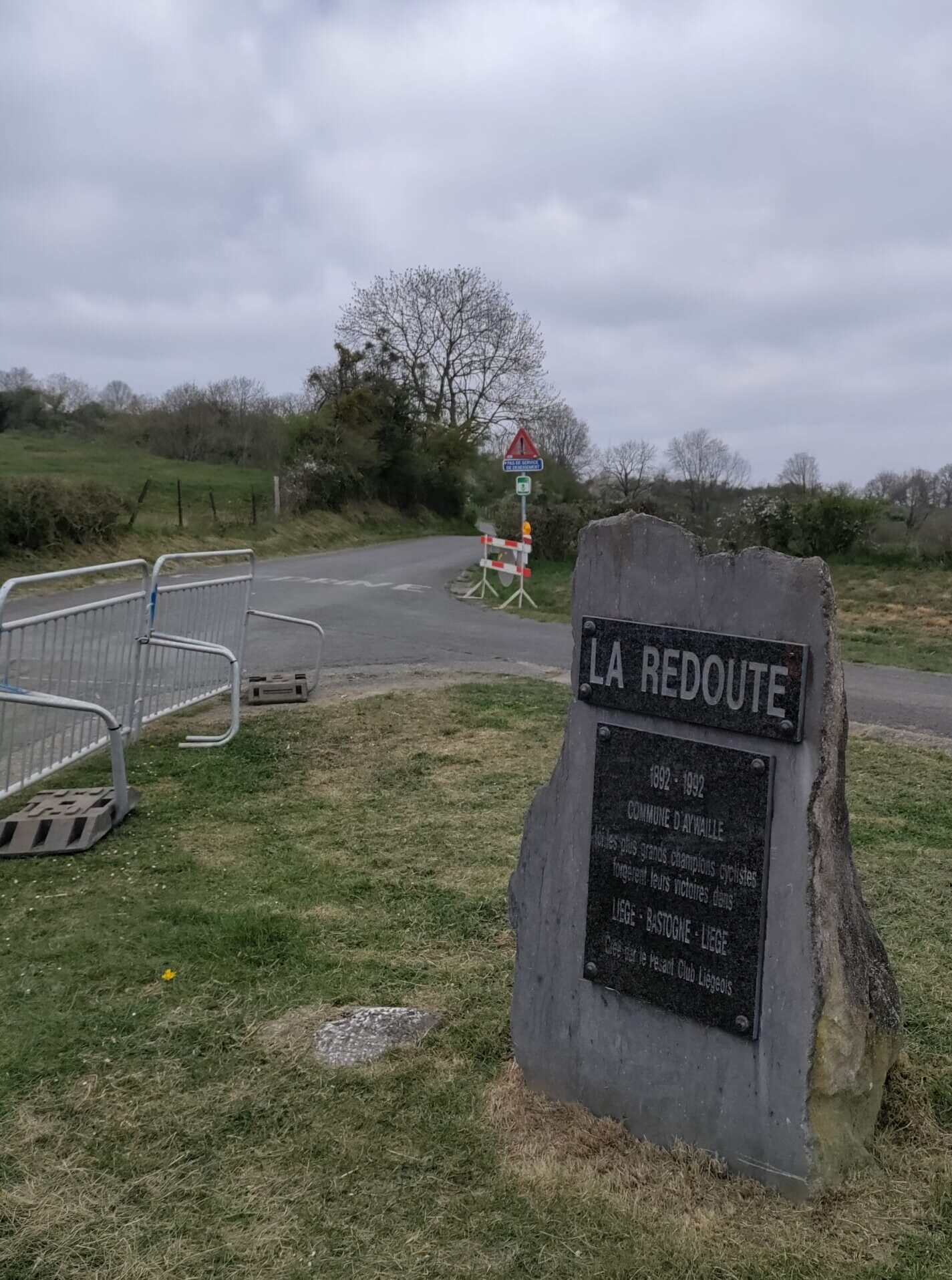
La Redoute is usually the point where the race breaks open, and it was also the key attack point in 2025. Roche-aux-Faucons, meanwhile, is often the last real opportunity to decide the race if a select group is still together.
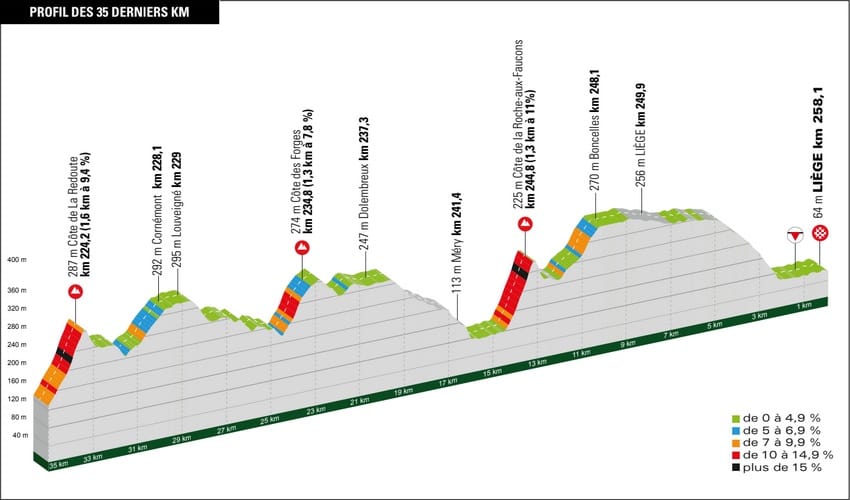
Overall reading of the climbs
If we combine the data from all the main climbs, a fairly clear pattern appears. The average gradient is around 8.5%, the maximum gradient reaches 12.5% on Stockeu, and the minimum sits at 5.1% on Wanne. Average length is around 2.1 km, with Rosier as the longest climb at 4.4 km, and Saint-Roch and Stockeu as the shortest at 1.0 km.
This defines the type of effort in Liège very well: climbs that are relatively short, but still long enough that they are not purely explosive efforts. Most key efforts fall into a 2 to 10 minute range, where watts per kilo become increasingly decisive, especially after more than 200 km of racing.
The route explains the type of winner
The profile of Liège does not favour the sprinter or the pure rouleur. It does not favour the pure climber built for long mountain passes either.
What it demands is something else: the ability to tolerate fatigue for more than five hours, to repeat maximal uphill efforts lasting several minutes, to maintain a high power-to-weight level over 3 to 5 minutes when the race is already very advanced, and, from a physiological point of view, to combine a high VO2max with a strong FTP. The reason is simple: most decisive efforts fall within the 2 to 10 minute range, where near-VO2 intensities meet the need to sustain submaximal power under fatigue.
The weight of the winners
Most winners fall roughly in a 59 to 70 kg range, with a concentration of light to mid-weight riders. The following body weights are approximate, since reliable data for the exact race day are not always available: Pogačar ~66 kg, Evenepoel ~63 kg, Roglič ~65 kg, Fuglsang ~67 kg, Jungels ~70 kg, Valverde ~61 kg, Poels ~66 kg, Gerrans ~62 kg, Dan Martin ~59–62 kg, Iglinskiy ~67 kg and Gilbert ~69 kg.
This reinforces the main idea: in Liège, watts per kilo under fatigue are decisive. That is why, for this race, a body weight between 60 and 70 kg seems to be the most favourable range.
Liège vs Tour of Flanders: same logic, different filter
Both races share one key element: repeatability of effort. But the type of effort is different. In Flanders, the race is defined by shorter, more explosive efforts that depend heavily on absolute power and the context created by cobbles. In Liège, by contrast, the efforts are longer, cleaner and more dependent on watts per kilo, since almost the entire race takes place on tarmac.
That is why riders such as Van der Poel, Pedersen or Ganna, who are dominant in Flanders, are not the profiles most favoured in Liège. Here, riders such as Remco or Pogačar are in ideal terrain.
What type of rider wins Liège
If we analyse the recent palmarès, two clear rider profiles emerge.
Light all-rounder
Fuglsang, Jungels, Gilbert or Gerrans fit this profile. They are complete riders, with strong ability on rolling terrain and enough climbing level to survive hard selections without needing to be pure climbers. They usually perform well in 5 to 10 minute efforts, but they are also capable of handling flat sections and managing accumulated fatigue well. Their weak point tends to appear on longer climbs above 20 minutes, but since Liège has none of those, they can perform very well if the race is not made excessively hard on the earlier climbs.
Fast climber
Pogačar, Evenepoel, Roglič, Valverde or Dan Martin are better examples of this second profile. Here the pattern changes slightly: these are riders with a higher watts-per-kilo ratio and the ability to produce very high power in 2 to 10 minute efforts. They do not need to wait. They can break the race with a single move on a key climb. This is probably the ideal profile for this race, although it usually requires attacking on one of the final climbs and then holding a time-trial effort to the finish. In modern cycling, this is the type of rider that has won most often.
These are not rigid categories, but they share two traits: relatively low body weight and high performance in efforts of several minutes after heavy fatigue. The difference between both profiles is not so much their level, but how they produce that power. The all-rounder usually wins through attrition, consistency and a strong sprint from a reduced group. The fast climber, by contrast, has more ability to create separation on a decisive climb. Liège allows both types of victory, but in modern cycling the second profile is becoming increasingly dominant.
What Liège teaches us from a training perspective
Liège leaves several clear practical lessons. Having a good climbing power peak matters, but it is not enough. The key question is how much you can still sustain when you are already fatigued.
To win a Liège, it is not enough to be very good at one single quality. What this race demands is a combination of real durability, meaning the ability to maintain performance after four or five hours of effort, and the capacity to produce very high power on climbs lasting three to ten minutes, repeated with incomplete recovery. The factor that decides almost everything is how much power you can still sustain when fatigue is already very high. This is a pattern we have already seen in other monuments we analysed in previous articles, both in Milano-Sanremo and, above all, in Paris-Roubaix or the Tour of Flanders.
Conclusion
Liège, even with 4,400 m of climbing, is not pure high mountain racing, but it is not a conventional classic either. It is harder to define with a single label: a race of progressive attrition where the decisive moment always arrives very late, when the legs are already carrying more than five hours of effort.
The rider who wins is not necessarily the most explosive or the best pure climber. It is the one who has managed everything that came before in the best possible way: the false flats, the unnamed rises and the high pace through the middle part of the race. And when the race finally breaks apart, on La Redoute, on Roche-aux-Faucons or even later, that rider still has power when others have nothing left. It is on those Ardennes ramps, after 250 kilometres, that the race reveals who truly has the right qualities and who only seemed to.
From a training perspective, this translates into something very concrete: if you want to perform well in efforts such as those required in Liège, you need to train durability, repeat uphill efforts and your ability to sustain watts per kilo under fatigue. And that is not something you improvise. It requires structured planning adapted to your profile.
If you want to apply these principles to your own case, you can do it here: the coach.
An individualised approach is what makes the difference between simply training and actually improving.