Table of contents
Three platforms for the same file
A cyclist with a power meter generates several megabytes of data every week: second-by-second power, heart rate, cadence, altitude, temperature. What happens with that data depends almost entirely on the platform it is uploaded to, and the three most common among amateur cyclists and coaches are Strava, TrainingPeaks and Intervals.icu. All three receive the same .fit file from a Garmin or a Wahoo and, from there, do very different things with it. Here we look at what each one does, where they overlap, where they don’t, and which makes more sense depending on what you want to get out of your training.
One thing up front: at JS Cycling Training we use Intervals.icu with every cyclist we coach, so this is not a neutral opinion. What we do try to do is explain the reasons and make them checkable.
What each platform is
Strava is a social network for athletes that also stores and displays activities. It was born in 2009 around segments (stretches of road with a leaderboard by time) and its whole design is still built around that: sharing the ride, comparing times with others and keeping a community going. The subscription adds some analysis tools, but the core product is the feed and the segments.
TrainingPeaks is a training planning and analysis platform that has been around since the early 2000s and for years has been the standard among coaches, particularly in the United States. It is where concepts everyone now uses came from: TSS (Training Stress Score, the load of a session), the PMC (Performance Management Chart, the Fitness, Fatigue and Form graph) and the normalised power model. Its business model is a Premium subscription for athletes and paid accounts for coaches. In July 2026 it was bought by Garmin, and we will come back to that further down.
Intervals.icu is an analysis and planning platform created in 2019 by a single developer, David Tinker, with most features free and an optional supporter subscription of around 4 dollars a month. It calculates the same metrics as TrainingPeaks (load, Fitness, Fatigue, Form, power curve), detects intervals automatically, estimates FTP, lets you plan and push structured workouts to your device and, what sets it apart, lets the user build their own fields, formulas and charts. If you don’t know it yet, we have a complete guide to Intervals.icu covering the initial setup and every section.
Load analysis: Fitness, Fatigue and Form
The load chart is the first thing a cyclist who takes training seriously looks for on any platform. A quick reminder of how it works: every session produces a load score (TSS in TrainingPeaks, Training Load in Intervals.icu and Strava) combining duration and intensity relative to FTP (the highest power you can sustain for roughly an hour). From that daily series two exponential averages are calculated, a long one over 42 days that we call Fitness (CTL) and a short one over 7 days that we call Fatigue (ATL), and the difference between them is Form (TSB). For example, a cyclist with Fitness 65 and Fatigue 95 has a Form of −30, which normally means they are in a loading block and this is not the moment for a test or a race; on the other hand, the same cyclist two weeks later with Fitness 68 and Fatigue 50 would have a Form of +18, typical of a well-executed taper.
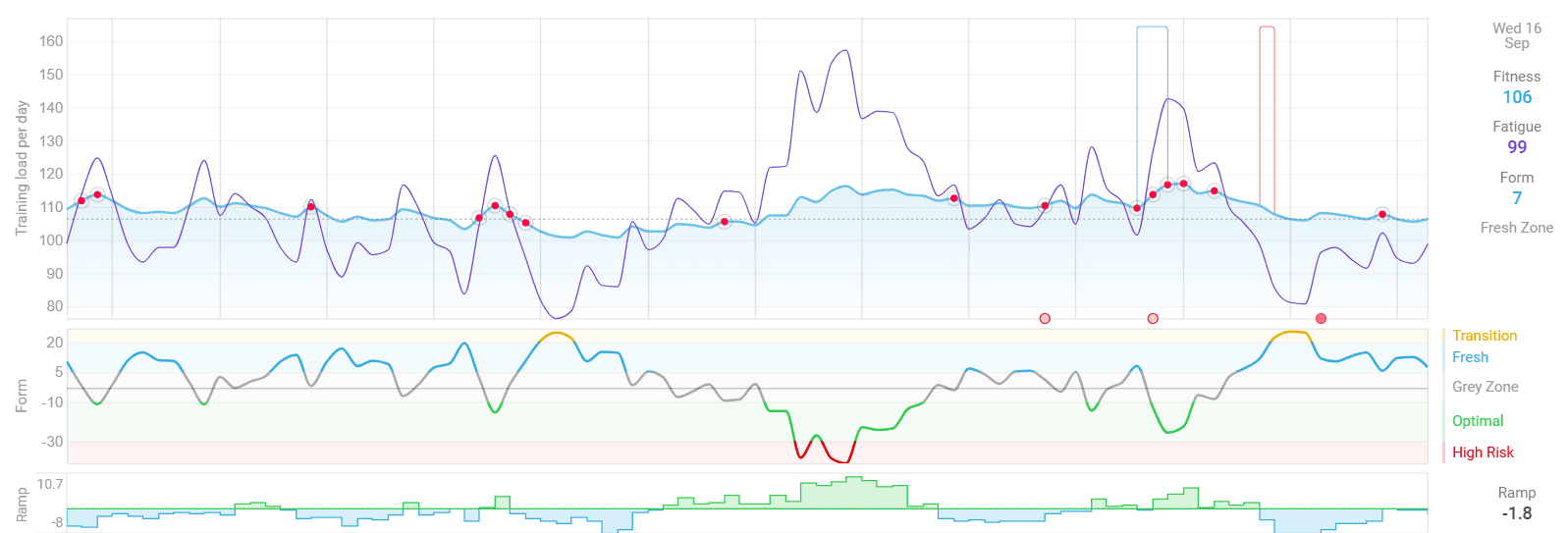
All three platforms draw this chart, but not under the same conditions. In TrainingPeaks the PMC is a Premium feature: with a free account you see your activities, but not how your load evolves. In Strava the equivalent is called Fitness & Freshness, also paid, and it has a design problem: without a power meter it uses heart-rate-based Relative Effort, which is reasonable, but it does not let you adjust the constants or separate sports, so a runner who also rides sees a single mixed curve. In Intervals.icu the chart is free, lets you change the 42- and 7-day constants (useful for masters cyclists, who tend to tolerate acute load less well), calculates load from power, heart rate or perceived exertion depending on what each session has available, and can be filtered by sport.
For most cyclists this is the most important practical difference: the load analysis that costs around 20 dollars a month on one platform is free and more configurable on another.
Power analysis: curve, FTP and intervals
The second block is the analysis of power itself. Here we distinguish three tools: the power curve (your best 5-second, 1-minute, 5-minute, 20-minute and so on values over a period), the FTP estimate and the analysis of the intervals within a session.
In Strava the power curve exists with a subscription, but that is where it stops. It does not estimate FTP, does not detect intervals, and analysing a ride is limited to viewing average power over manually selected sections. It is enough to know whether you rode harder today than last month on your usual climb, and not much more.
TrainingPeaks has the power curve, peak powers by period and a good interval editor, all within Premium. The truly advanced analysis (modelling the power curve with metrics such as FRC, the work capacity above FTP, or TTE, the time FTP can be sustained) lives in WKO5, a separate desktop program with a one-off licence, which has also gone quite some time without meaningful updates.
Intervals.icu detects intervals automatically when the activity is uploaded (if you did 5 sets of 4 minutes, they appear labelled with their power, heart rate and cadence without you doing anything), estimates FTP from the curve (eFTP) and warns you when the last 42 days suggest the configured value is now too low, shows W’ (the energy available above FTP, in kJ) and compares the power curve of any period against any other. All of this is free. It does not reach WKO5’s level of modelling, but for making training decisions it covers around 90% of what a coach needs to look at.
Planning and pushing workouts to your device
A structured workout (say, 15 minutes of warm-up, 4 sets of 8 minutes at 95% of FTP with 4 minutes of recovery, and 15 minutes of cool-down) can be written on the platform and sent to the bike computer so the device itself guides the session. This feature makes a big difference to how well workouts get executed, especially on the trainer, so it is worth knowing who offers it.
Strava does not have it. It is not a planning platform and does not try to be one.
TrainingPeaks has it and it is one of its long-standing features: the calendar, the workout builder and sync with Garmin, Wahoo and most devices. Planning your own future workouts and pushing them as structured sessions generally sits on the Premium side; with a free account you can follow the plan a coach gives you, but not build it yourself.
Intervals.icu has it too, for free, with a text-based workout builder that turns out to be faster than TrainingPeaks’ once you get the hang of it (a line such as “4x 8m 95% 4m 50%” generates the whole structure), and it syncs with Garmin, Wahoo, Hammerhead, Zwift and others. It also lets you build multi-week plans and apply them to the calendar.
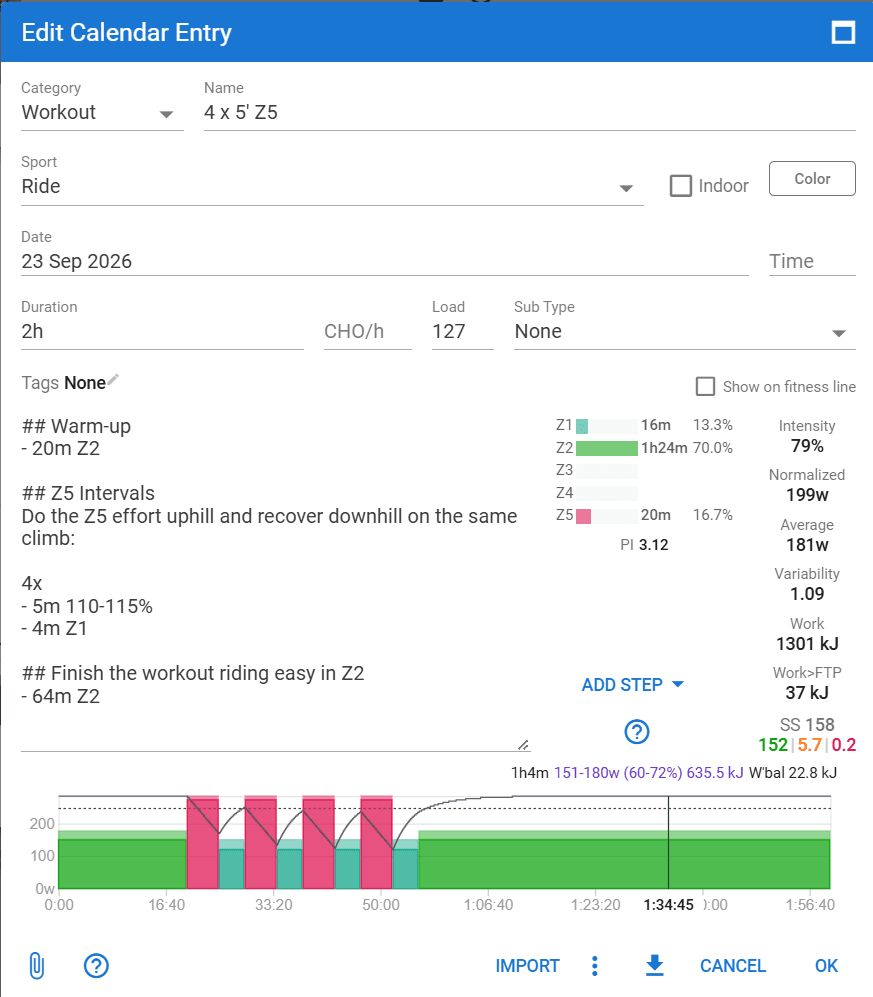
So the self-coached cyclist and the coached cyclist have the same planning capabilities in Intervals.icu as in TrainingPeaks, with the price difference we will get to.
Customisation: your own fields, formulas and charts
This is the area where Intervals.icu has no competition, and it is the main reason we use it. Any user can create a custom field with a formula (for example, the ratio between power and heart rate of a session, or the accumulated load of the last 3 days divided by that of the last 28), a custom chart that plots that field over time, and a dashboard with whichever charts they care about, all inside the platform without exporting anything. Wellness variables (sleep, HRV, weight, how you feel) can be logged and crossed with load, and there is an open API for anyone who wants to go further.
TrainingPeaks offers configurable dashboards in Premium, but by choosing among predefined charts; new metrics cannot be created within the web app. For that you need WKO5. Strava offers nothing in this area.
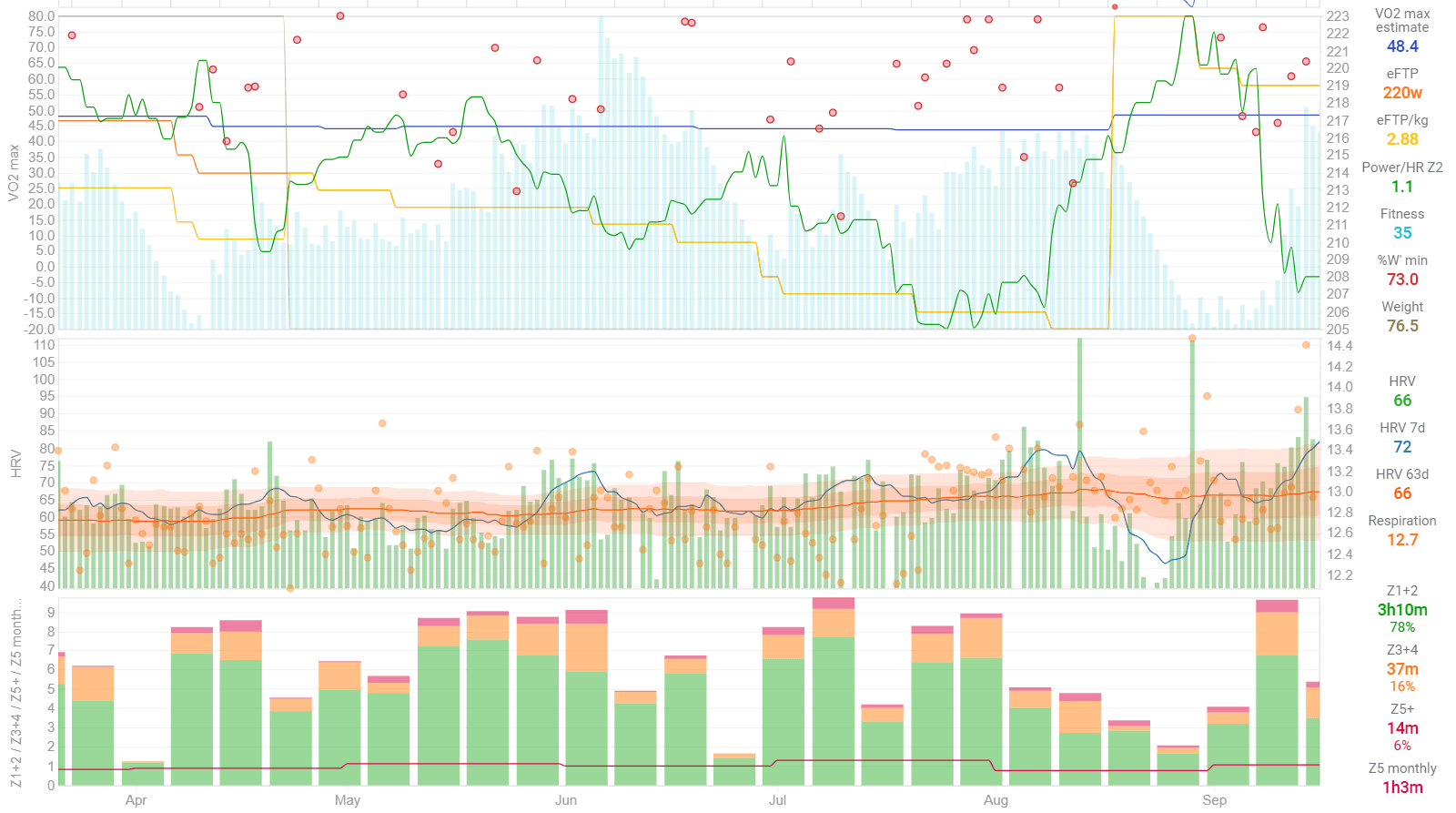
In practice this means a coach can set up a dashboard with the three or four things they look at every Monday for each cyclist and never have to go through a spreadsheet. We will devote a whole article to this part, because it is where the biggest difference in value lies.
Price
Figures as of September 2026, in the currency each platform publishes them in:
- TrainingPeaks: Premium costs 19.95 dollars a month or 134.99 dollars a year (equivalent to 11.25 a month). The free account lets you upload activities and follow a coach’s plan, but leaves out the PMC and most of the analysis.
- Strava: the subscription costs 11.99 dollars a month or 79.99 a year in the United States; in Europe it usually lands between 8 and 11 euros a month depending on the country, with the annual plan working out at around 6 or 7 euros a month. The free version keeps activity logging, segments with a limited leaderboard and the social side.
- Intervals.icu: free, with no time limit and no essential feature held back. The Supporter subscription costs 4 dollars a month and adds secondary features such as importing your full Strava history, fully custom zones, the annual planner and tools for teams and coaches with many athletes.
Over a year, a cyclist who wants load analysis and planning pays around 135 dollars on TrainingPeaks, around 80 on Strava (with no planning) and 0 or 48 dollars on Intervals.icu. The difference is not what weighs most in the decision, but it is worth keeping in mind because the analysis you get in return does not move in the same direction as the price.
Side-by-side summary
| Feature | TrainingPeaks | Strava | Intervals.icu |
|---|---|---|---|
| Fitness, Fatigue and Form | Premium | Subscription, sports not separated | Free, configurable constants |
| Power curve | Premium | Subscription | Free |
| FTP estimate | Premium (WKO5 for modelling) | No | Free (eFTP and W’) |
| Automatic interval detection | Manual editor | No | Free, automatic |
| Plan and push workouts to device | Premium (following a coach’s plan: free) | No | Free |
| Custom fields, formulas and charts | WKO5 only | No | Free |
| Wellness log (sleep, HRV, weight) | Yes | No | Yes |
| Social network and segments | No | Yes | No |
| Annual price with full analysis | $134.99 | $79.99 | $0 ($48 as Supporter) |
Which one to use depending on what you want
Three cyclist profiles cover most cases.
The first is the cyclist who rides two or three times a week, does not train in a structured way and mainly wants to share rides and compare themselves on the local climbs. For this profile Strava is enough, and probably the free version; paying for the subscription makes sense if they use routes or live segments a lot, not for the analysis.
The second is the self-coached cyclist with a power meter who tests periodically and wants to know whether the load they are accumulating makes sense. Here I would set up Intervals.icu as the analysis and planning platform and keep Strava connected as a data source and social network if they want it. The two coexist without any trouble: the activity comes in through Strava or directly from Garmin or Wahoo, and Intervals.icu analyses it. TrainingPeaks adds nothing this cyclist does not already have in Intervals.icu, and costs them 135 dollars a year.
The third is the cyclist who works with a coach. In this case the decision is not theirs but the coach’s, because what matters is that both look at the same data in the same place. If the coach works in TrainingPeaks, the cyclist does not need Premium: the free account is enough to receive workouts and upload activities. If the coach works in Intervals.icu, as we do, the cyclist also gets the full analysis at no cost. On the other hand, if the cyclist wants to dig into the data beyond what their coach shows them, and the coach uses TrainingPeaks, they will find that much of what they want to see sits behind Premium.
On Garmin’s purchase of TrainingPeaks, announced on 22 July 2026: Garmin has stated that the platform will keep working with other brands’ devices and has announced no price changes, so there is no reason to leave today. There is reason, for anyone deciding now, to keep in mind that TrainingPeaks is no longer independent, and that Intervals.icu depends on a single developer, which is a different kind of risk, although so far it has meant frequent updates rather than neglect.
What does not change with the platform is the data going in. A badly set FTP gives a badly calculated Fitness on all three, an uncalibrated power meter gives a false power curve on all three, and an unrecorded session exists on none of them. The platform decides what can be seen; the quality of what is seen is decided by the cyclist before the file is uploaded.