Table of contents
- Losing performance is not the same as being in danger
- A cyclist riding at 250 W produces as much heat as a toaster
- Sweating does not cool you. Evaporation does
- Cooling costs watts
- How far the system can go
- Not every rider pays the same cost—or on every terrain
- Heart rate is still useful—it is measuring something different
- How to train through a normal summer
- Heat is not an inconvenience. It is a training-load variable
- Bibliography
Losing performance is not the same as being in danger
You set off on your usual route at the end of a heavy training week, riding at the same perceived effort, and come home producing fewer watts with your heart rate 15 beats higher. The usual explanation is that it was hot. That is where the analysis ends.
Heat, however, rarely acts alone. You were also carrying fatigue from earlier sessions, and you may have slept poorly or eaten too little. All of those factors push in the same direction. Blaming everything on the thermometer is as unhelpful as ignoring it, and separating the contribution of each factor is the hardest part of interpreting a summer ride. Here I will isolate the thermal variable, because accumulated fatigue, sleep and nutrition each deserve their own analysis. Mixing them together does not help you understand any of them.
There is another distinction within heat stress that is rarely made. The temperature at which performance starts to fall and the temperature at which heat becomes dangerous are not the same. They are not even close. More than ten degrees can separate the two, and that is the range in which you train throughout the summer.
Knowing where you are within that range changes specific decisions: when to ride, which session to schedule and how to interpret the data afterwards. Heat is not a seasonal inconvenience. It is a training-load variable, and one of the variables that can change a session most even when you change nothing yourself.
A cyclist riding at 250 W produces as much heat as a toaster
This comparison is a useful way to understand where the problem begins.
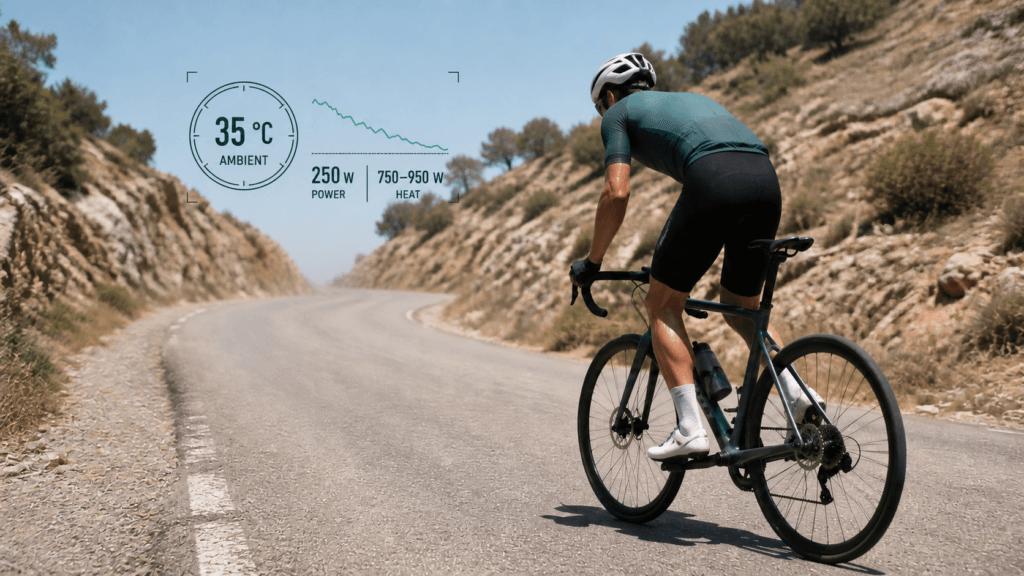
The human body converts only 20-25% of the energy it uses into mechanical work. The rest becomes heat. To produce 250 W at the pedals, you expend roughly 1,000-1,200 W of metabolic energy, which means you continuously generate 750-950 W of heat. A domestic toaster operates at around 800-1,000 W.
When you ride at a demanding endurance pace of 250 W, you are a heat source comparable to a toaster—and you are carrying that toaster inside you.
In winter, this is not a problem. With the air at 10 °C and your skin close to 30 °C, the temperature difference is enough for heat to escape through convection and radiation, while moving air does the rest. You barely notice it.
In summer, that margin disappears. While cycling, skin temperature is typically around 33-35 °C. If the air is at 30 °C, you have only two or three degrees of difference through which to release almost a kilowatt of heat. If the air reaches 36 °C, the gradient reverses: instead of losing heat through convection, you gain it.
At that point, you have only one lever left.
Sweating does not cool you. Evaporation does
That lever is sweat, with one condition that is rarely mentioned: sweat dripping onto the ground provides no cooling. You lose water and electrolytes without gaining any heat relief.
Cooling comes from the change of state. Water needs energy to move from liquid to vapour, and it draws that energy as heat from your skin. Evaporating one litre of sweat per hour dissipates roughly 670 W. Compare that with the 750-950 W you are producing and it becomes clear why sweating changes from a detail into your main cooling system as the temperature rises.
The catch is that evaporation does not depend only on you. It depends on two external factors: how much moisture is already in the air and how much air is moving across your skin.
The first factor makes simple temperature comparisons unreliable. Thirty-five degrees in a dry, well-ventilated environment can be entirely manageable for a heat-acclimated cyclist, while 32 °C at 70% relative humidity can be substantially worse. The air can accept very little additional water vapour, so your best cooling mechanism operates at a fraction of its capacity. That is why air temperature alone tells you so little, and why the apparent temperature is a more useful number to check before choosing your session.
The second factor is underestimated even more because it is not set by the weather: you create it through speed. The airflow across your skin at 30 km/h on flat roads is completely different from what you receive while climbing at 13 km/h. Same day, same air temperature, radically different cooling capacity.
The body’s cooling system works well overall. But it does not work for free.
Cooling costs watts
This is the first of two limits, and it appears much earlier than most riders think.
Sending blood to the skin and producing sweat are not neutral operations. Blood directed to the surface to release heat is blood that is not serving the working muscles. Your heart must beat faster to sustain the same workload, and perceived exertion rises with it. Even efficiency suffers: in laboratory testing, gross efficiency was about 0.9% lower when cycling at 35 °C than at 15 °C, a difference large enough to explain roughly half of the performance loss in that type of test [1].
Field data point in the same direction. An analysis of 74 professional cyclists found that peak power records clustered between 10 and 25 °C, with performance falling by 9-16% at the extremes, both in severe cold and in heat above 35 °C [2]. As a practical benchmark for an amateur rider, I would place the favourable range at an apparent temperature of 15-24 °C.
The important point is where this deterioration comes from. It does not happen because your body can no longer cool itself. It happens because cooling consumes resources. You are paying a physiological toll while the system is still working correctly and you are nowhere near a dangerous limit.
The limit everyone talks about—the true danger zone—is much higher.
How far the system can go
If you wake up tomorrow with a temperature of 39 °C, you stay in bed. On the bike today, you may have reached the same core temperature and kept riding.
That is possible because core temperature is not fixed at 37 °C. It is a value the body regulates, not a constant, and it changes during exercise. As long as blood redistribution and sweating keep doing their job, core temperature rises in a controlled manner without anything significant happening. Race data show how far that range can extend: core temperatures as high as 41.5 °C were recorded in riders who finished the UCI Road World Championships in extreme heat [3]. This finding needs to be read carefully. It describes acclimated professionals racing with support, not a target to reproduce on an ordinary Tuesday.
The system becomes overwhelmed in three situations: very high intensity, very high temperature, or moderate temperature combined with high humidity. The first increases how much heat you generate; the other two restrict your ability to release it. Combine them and the problem becomes worse.
When that happens, the warning signs are fairly clear. Dizziness, a heart rate far too high for the power you are producing, chills in 35 °C heat, skin that stops sweating, or a sense of mental and physical confusion do not mean you are simply having a hard day. They are warnings that the cooling system is overwhelmed. The genuinely dangerous range begins above roughly 40 °C core temperature, and you cannot see it coming far in advance from inside your own body. If any of these signs appear, stop, find shade and cool yourself by pouring water over your body or drinking something cold. Do not bargain for another two minutes.
Because skin temperature sits around 33-35 °C, once the air exceeds that range you stop losing heat through convection and become dependent on evaporation. If humidity is also high, that final lever closes too. This is why safety limits should not be assessed from air temperature alone but from apparent temperature. As a practical guide, allowing for substantial individual variability:
- Below an apparent temperature of 28 °C: normal training, with hydration adjusted to conditions.
- From 28 to 32 °C: trainable, but be cautious with long intervals.
- From 32 to 35 °C: reduce intensity or duration. I would already avoid high-intensity work.
- From 35 to 38 °C: short, easy sessions, and only if you are acclimated.
- Above 38 °C: an indoor trainer with a fan is the better option.
- Above 40 °C: I would not schedule outdoor training.
Two warnings apply to this table. Many studies use unacclimated participants with limited airflow, which is harsher than riding on the road at 30 km/h, so laboratory thresholds tend to be conservative. These values are decision criteria, not physiological constants. They do not apply equally to everyone.
Not every rider pays the same cost—or on every terrain
You often hear that larger cyclists suffer more in the heat. That is only half true, and the missing detail is what makes the idea useful.
The underlying reason is geometry. Heat production scales with body volume, while heat dissipation scales with surface area, and the two do not increase at the same rate. Take two people with similar proportions who are 1.60 m and 1.80 m tall. Their height differs by 12.5%, but skin surface area increases by 27% and body mass by 42%. In the variable that matters—skin surface area per kilogram—the 1.80 m rider has roughly 11% less radiator for every kilogram that must be cooled.
Think of it as a car. Muscle is the engine and skin is the radiator. As body size increases, the engine grows faster than the radiator.
But this only becomes a disadvantage when the required power scales with body mass, and on flat terrain it does not. On the flat, aerodynamic drag is the main resistance, and drag is linked to frontal area, which scales roughly with body surface area. The larger cyclist generates around 20% more heat to ride at the same speed but has 27% more skin through which to release it. The larger rider does not lose on flat roads and may even hold a slight advantage.
Everything changes on a climb. Gravity scales with kilograms: more mass means more watts and more heat. Skin area has not increased at the same rate. This is where the 11% disadvantage appears. You are also climbing at 13 km/h instead of riding at 35 km/h, so the other driver of evaporation—airflow—turns against you as well. A climb increases heat production and reduces cooling at the same time.
There are three limits to this argument. The flat-road calculation assumes frontal area scales with body surface area. That is a reasonable approximation, not an exact rule, because riding position can matter as much as body size. Active muscle produces heat, not total body weight, so fat adds mass without generating heat and also acts as insulation; two riders of the same weight can respond differently. None of this is deterministic. Sweat rate and acclimation status can shift the balance more than body size.
The practical application is much clearer. If you are a larger cyclist, heat acclimation and cooling strategies are not optional summer extras. They are part of your preparation for climbing.
Heart rate is still useful—it is measuring something different
All of this has a direct consequence for the data you inspect after a ride, and one common interpretation needs correcting. Riders often say heart rate is useless in summer. That is not true. What has changed is what it measures.
In cool conditions, heart rate works reasonably well as a proxy for intensity: more watts, higher heart rate. In the heat, that relationship breaks down for the reasons already discussed. Your heart is supporting both muscular work and blood flow to the skin, while plasma volume falls as fluid is lost through sweat. Heart rate rises without any increase in mechanical work.
Put differently, heart rate stops being only an intensity marker and becomes a marker of thermal strain. As a thermal-strain marker, it is one of the best tools available: it costs nothing and you already wear the sensor.
This gives you two specific uses. The first is to quantify what the conditions are costing you. Compare your heart rate at a given power with your heart rate at the same power in spring. The difference is a reasonably direct measure of the session’s thermal cost, while heart-rate drift at constant power shows how that cost accumulated during the ride. The second use is more valuable over time. Repeat the same climb at the same power and, if your heart rate falls week by week, you are acclimating. It is the cheapest way to verify that adaptation.
The reverse approach—prescribing intensity from heart rate in peak summer—makes little sense. If you follow heart-rate zones on a 33 °C day, you will probably produce substantially fewer watts than intended because your heart rate reaches the target zone before your muscles reach the workload you wanted.
This confusion creates a common mistake: I came home exhausted, so I must have trained hard. A high heart rate tells you how much you paid, not what you bought. An interval session at 34 °C can leave you shattered while delivering much less of the intended stimulus, because the limiting factor was not your engine but your ability to dissipate heat.
Unless you are preparing to race in the heat, in which case thermal stress belongs in the plan, the sensible choice on an extremely hot day is not to complete the same session with worse numbers. Move it to early morning, replace it with useful low-intensity volume, or ride indoors with a strong fan and execute it properly. None of those options is surrender. All three protect the stimulus you actually wanted.
How to train through a normal summer
Heat acclimation offers the best cost-to-benefit ratio because it addresses the problem at its source: greater plasma volume, earlier and heavier sweating, lower heart rate and lower core temperature at the same workload. Changes begin within a few days of exposure, while the full effect usually requires about two weeks of daily 60-90-minute heat sessions [4]. In trained cyclists, two weeks of acclimation improved power during a time trial in the heat, although it did not fully reproduce performance in cool conditions [5]. You regain some of the lost ground, not all of it.
From there, these are the decisions that genuinely change a summer of training:
- Schedule quality work early. The difference in apparent temperature between 7:00 and 13:00 is often greater than anything you can achieve by modifying the workout itself.
- If you will race in the heat, acclimate deliberately for 10-14 days beforehand instead of expecting summer weather to do the job by chance.
- On an indoor trainer, a fan is not a comfort item. It is the difference between evaporating sweat and simply dripping it onto the floor.
- Once a hot-weather session extends well beyond an hour, replace sodium as well as water.
- Cool yourself before and during the ride: use a cold or iced drink before starting and at stops.
- On climbs, plan slightly less intensity than usual and evaluate the session through power and perceived effort, using heart rate to measure what it cost you.
Heat is not an inconvenience. It is a training-load variable
You begin to lose power at around an apparent temperature of 24 °C, but the genuinely dangerous range is much higher and depends primarily on humidity and airflow, not the number on the thermometer. Between those points is a wide range in which you can train effectively, provided you accept that the numbers will change and that heart rate is telling a different story.
Interpreting a hot day correctly is not about tolerating more discomfort. It is about knowing what you are measuring and which stimulus you are actually buying. If you want to adapt your summer training to your own data and context, that is exactly the type of decision I work through with the cyclists I coach.
Bibliography
[1] Hettinga FJ, De Koning JJ, de Vrijer A, et al. The effect of ambient temperature on gross-efficiency in cycling. Eur J Appl Physiol. 2007;101(4):465-471. PubMed
[2] Valenzuela PL, Mateo-March M, Zabala M, et al. Ambient Temperature and Field-Based Cycling Performance: Insights From Male and Female Professional Cyclists. Int J Sports Physiol Perform. 2022;17(7):1025-1029. PubMed
[3] Racinais S, Moussay S, Nichols D, et al. Core temperature up to 41.5 °C during the UCI Road Cycling World Championships in the heat. Br J Sports Med. 2019;53(7):426-429. PubMed
[4] Périard JD, Racinais S, Sawka MN. Adaptations and mechanisms of human heat acclimation: applications for competitive athletes and sports. Scand J Med Sci Sports. 2015;25(Suppl 1):20-38. PubMed
[5] Racinais S, Périard JD, Karlsen A, Nybo L. Effect of heat and heat acclimatization on cycling time trial performance and pacing. Med Sci Sports Exerc. 2015;47(3):601-606. PubMed
[6] AI-generated cover image