Table of contents
Every spring the same idea comes back: Paris Roubaix is the race for the strongest rider. That is only half true. Roubaix demands huge power, of course, but that still does not fully explain why some riders survive while others fade out of the equation much earlier than expected.
More than a pure engine race, Roubaix is a race of trade-offs: speed versus control, aerodynamics versus stability, being at the front versus not paying too much for it. In 2026, that logic is once again very clear. The men’s route covers 258.3 km, 30 sectors and 54.8 km of pavé — the characteristic cobbles of Roubaix — , with a very dense entry into the key sectors from early on. In other words, what matters is not only how much pavé there is, but how it is distributed and when it forces riders to pay the price.
The cobbles are not just a hard surface: they are an energy problem
The first defining feature of pavé is speed. On smooth roads, at race speeds, most of the energetic cost usually comes from aerodynamics: as a useful rule of thumb, on flat terrain around 80–90% of total resistance can be aerodynamic, with the rest coming mostly from rolling resistance and mechanical losses. But in Roubaix that advantage does not transfer to pavé in the same way. Vibration, bouncing, reduced traction, a less clean application of force and a clear rise in contact-related losses all come into play.
The practical consequence is significant: to hold the same speed on Roubaix-style pavé, the additional cost can be roughly +60 to +120 W compared with good asphalt, and on the roughest sectors it can go even higher. At around 40 km/h, a reasonable reference for professional riders is to think in terms of something close to an extra +80 to +120 W.
That is why sitting on a wheel over pavé is not as “cheap” as it is on asphalt. That extra surface-related cost is barely given back by the draft. With the same 350–400 W, a rider can lose roughly 3 to 9 km/h when moving from good asphalt to Roubaix-style pavé, depending on how broken the sector is.
The second issue is the cost of control. On pavé, not all the energy produced by the rider turns into useful forward motion. Some of it is lost in micro-corrections, body movement, impact absorption, small traction losses and line changes. That means two riders with similar watts can move at different speeds if one tolerates the surface better, chooses a better line or rides a more stable setup.
Positioning is not a tactical detail: it is race structure
In many classics, positioning is described as something important. In Roubaix, it is more than important: it is structural.
Entering a sector too far back does not only mean losing a few places. It means more braking, more re-accelerations, more traffic, a higher risk of splits and many more chances of puncturing, touching wheels or getting trapped behind someone else’s crash. It is also especially important here to enter the pavé sectors with speed: if you have to brake, you can no longer hold the same speed as the front group and the gaps begin to grow. In a normal race that may cost one effort. In Roubaix it can cost the whole race if you end up in the back group at the key moment.
Very often a favourite is not taken out because his legs fail, but because the race forces him to waste useless energy correcting a problem that had already been created by poor positioning.
Mechanics and equipment: they will not make you win, but they can make you lose
Roubaix is also a race of engineering applied to survival. Equipment does not win on its own, but a poor setup can absolutely ruin your day.
The classic dilemma is tyres and pressures. More volume and lower pressure usually bring more grip, control and absorption on pavé, but if you go too far other problems appear: burping, vague handling or worse response on asphalt.
That is why equipment in Roubaix is not about searching for the perfect setup, but for the best possible compromise between asphalt and pavé, speed and control, efficiency and tolerance to chaos.
The team matters a lot too. Good mechanical service, well-positioned team cars and team-mates capable of moving you up or helping in key moments all change the real value of the equipment. In such a fragile race, logistics are also part of performance.
The pavé of Roubaix
Saying that Paris-Roubaix has more than 50 km of pavé sounds insane, but the figure alone explains very little. What matters is when those sectors arrive, how much asphalt lies between them and how much fatigue has already accumulated when they are tackled.
The official route of the 2026 Paris-Roubaix reinforces that idea once again: what matters is not only how much pavé there is, but how it is distributed and when it forces riders to pay the price.
That changes the reading of the day. The first block does not usually decide who wins, but it can decide who stops mattering. Later, something similar happens on the run toward Mons-en-Pévèle and finally in the Camphin + Carrefour block. In all those moments, it is not only the hardness of the individual sector that matters, but the fact that they arrive when the race is already damaged.
Distribution of the pavé sectors
The most useful way to understand Roubaix is to see it as a race of submaximal intervals with incomplete recovery. In the decisive part of the race, the average pattern looks more like blocks of roughly 2’15–2’30 on pavé followed by 4’00–4’20 on asphalt than like long efforts with real recovery.
And this is the key physiological point: that asphalt often does not allow genuine recovery. It is used to reposition, chase, close gaps or prepare the next entry, so internal load drops only slightly. That is why Roubaix does not punish riders only because of the power needed in each sector, but because of the ability to repeat efforts when neuromuscular fatigue has already accumulated in the arms, shoulders, core and legs.
The five-star sectors
Not every stretch of pavé has the same value. Talking about “the cobbles” in general often hides what really matters: there are only a few sectors that truly change the race because they combine difficulty, location and selection power.
Trouée d’Arenberg: the great filter
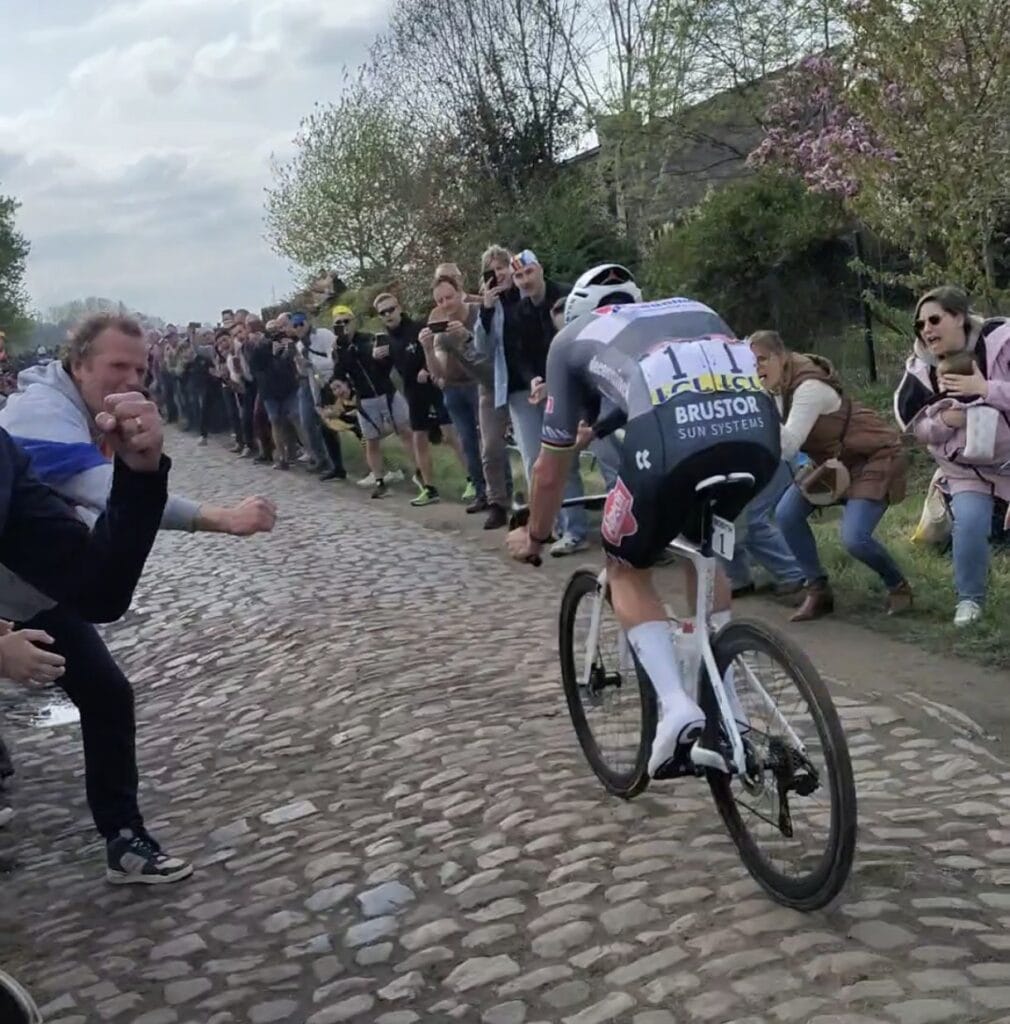
Arenberg does not always decide who wins, but it very often decides who can no longer win. In 2026 it appears again at km 163 and keeps its official 2,331 m. In fast editions, the front of the race can cover it in a little over 3 minutes; the highest recent reference is the 3:04 recorded in the race in 2025. Although it looks less technical because it is a straight sector with no corners, it is one of the sectors with the worst pavé surface.
That already gives a clue about the nature of the effort: it is not “long” in absolute terms, but it is a block of extremely high tension. The entry, the fight for line, the micro-corrections and the impossibility of relaxing turn that passage into the first great filter.
In addition, the recovery afterwards is poor. Getting out of Arenberg alive does not mean the critical zone is over; it means entering another phase of the race with less margin.
Mons-en-Pévèle: the most metabolic sector
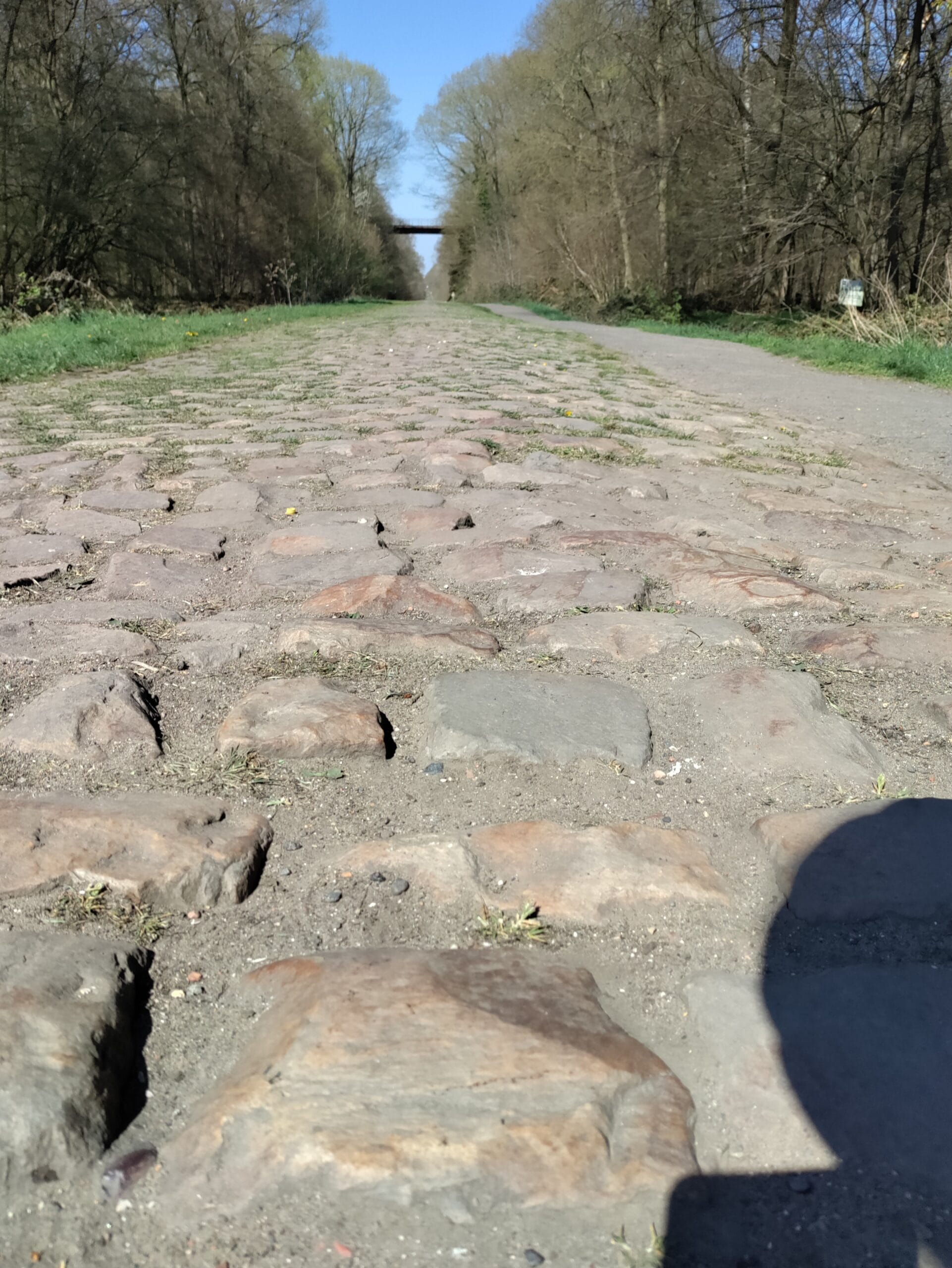
Mons-en-Pévèle is probably the most suffocating five-star sector from a physiological point of view. It measures 2,998 m and arrives when the race is already heavily hardened. In a fast edition, the front usually covers it in the low 4-minute range, with public references around 4:07.
Here the feeling is less about explosive chaos and more about sustained hammering. If a rider enters with the tank half empty, it is not one acceleration that kills him, but the inability to sustain traction, speed and control for several minutes when there is not much left in reserve.
That is why Mons hurts so much: it does not finish off only those who are poorly positioned, as Arenberg can do, but also those who were already suffering even if they still seemed to be in the race.
Camphin + Carrefour de l’Arbre: the final guillotine
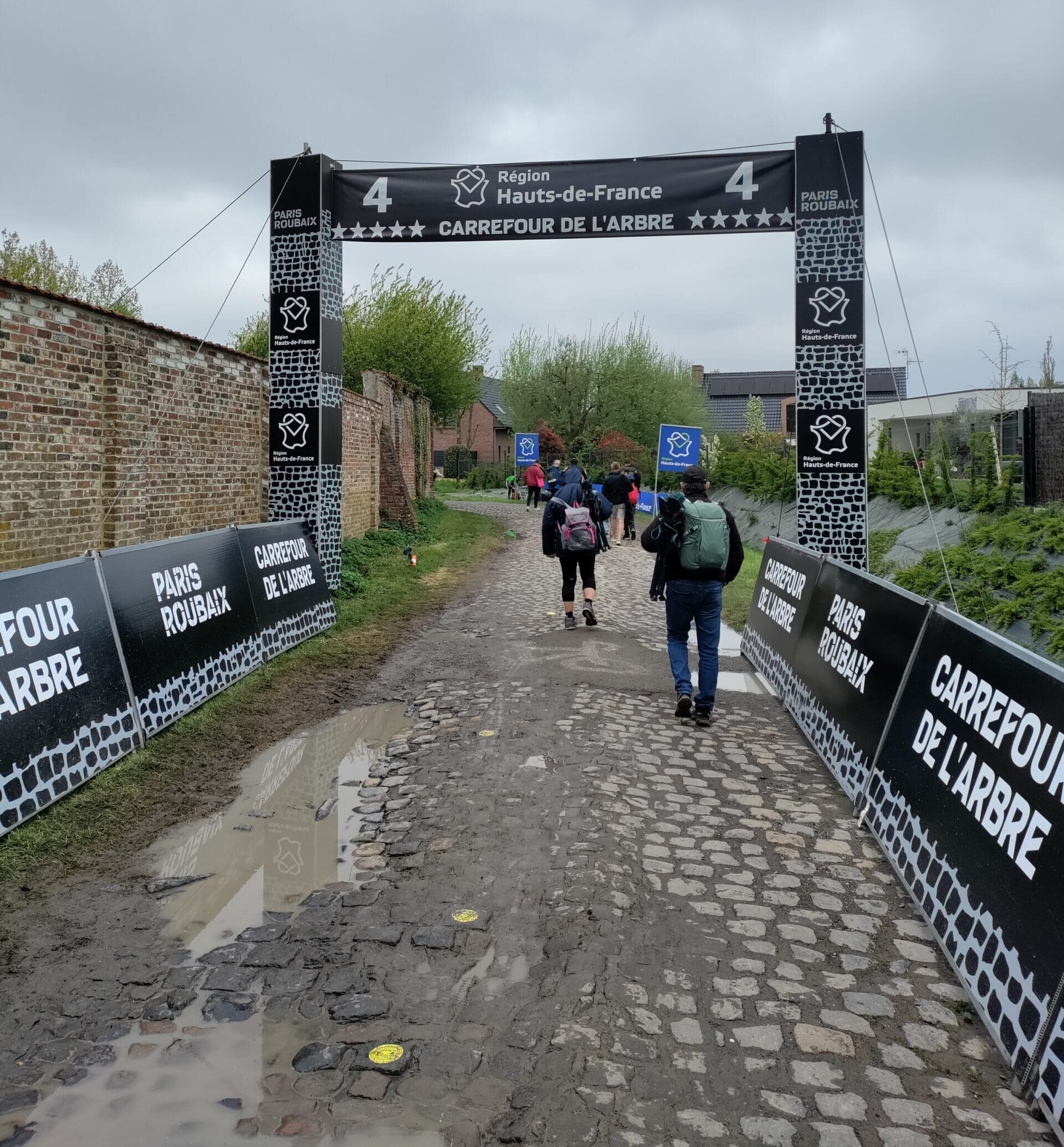
Carrefour remains the last great launchpad of the race. Officially it is 2,109 m long and sits only 17.1 km from the finish, but reading it in isolation is a mistake. What really matters is the block it forms with Camphin: almost 4 km of pavé in less than 5 km total.
At that point, it is no longer only the rider who pushes hardest who wins. The winner is the one who can still apply power precisely. Carrefour has corners, line changes, very broken surfaces and a heavy penalty for riders who arrive with tired hands, shoulders or core. In fast conditions, the sector is usually closer to 3 minutes than to 4, and on the shorter public segments there are even references below that. But the important idea is not the isolated time on the clock, but the type of damage it concentrates.
Although it may be the best-conditioned pavé of the three five-star sectors, the proximity to the finish, the length of the final block and the corners make it a decisive point.
Roubaix-specific fatigue
Roubaix produces a different kind of fatigue from many other classics. Not only because of duration, but because of the type of aggression it accumulates.
Vibration and impacts create continuous neuromuscular stress. Arms, shoulders, back and core work far more than a conventional power reading would suggest. The rider is not only pedalling: he is stabilising, absorbing, correcting and protecting the bike for hours.
This has several consequences. One is that eating and drinking become more difficult, especially when the terrain does not allow riders to take their hands off the bars easily or when the body is already heavily fatigued. Another is that technical fatigue appears earlier: when the system is at its limit, line choice gets worse, corrections are slower and small mistakes start to chain together into seconds lost or mechanical problems.
Technique on pavé
Technique on pavé is sometimes presented as a secondary skill. In reality, in Roubaix it is a direct form of performance.
Choosing the right line inside the sector, avoiding the harshest stones, deciding when the side is worth using and when it is not, and reading the terrain according to moisture, dust or rider traffic are all skills that change real speed. Not because they magically turn an average rider into a winner, but because they reduce losses and unnecessary accelerations.
A technically refined rider arrives less battered, makes fewer corrections, brakes less and re-accelerates less. That means better Roubaix-specific economy.
What profile do these conditions usually reward?
The recent list of winners reinforces a fairly stable idea: Roubaix tends to favour a powerful, robust rouleur with high absolute power, far from the prototype of a light climber.
If we take the last 15 editions raced between 2010 and 2025, a clear pattern appears. Average height is around 1.85 m and average weight about 77 kg. The most repeated range sits roughly between 74 and 82 kg. That is not a coincidence.
That profile tends to combine four things especially well in Roubaix: high absolute power, more inertia on broken terrain, greater stability on the bike and the ability to sustain speed when the surface prevents a perfect application of force. That is why the race usually rewards a very specific type of rider.
Conclusion
Paris-Roubaix does not answer only the question of who has the biggest engine, but also the question of who can best sustain performance when the terrain, the mechanics and the chaos begin to dismantle the race.
What is interesting is that this logic is not exclusive to the pros. Many of the reasons why Roubaix destroys the best riders in the world are the same reasons why it is valuable for any cyclist or for anyone working with a cycling coach: managing effort under chaos, resisting accumulated fatigue and holding technique together when the body has little left.
L’Enfer du Nord. Hell of the North. A race that, seen up close, teaches more about real cycling than many others put together.