Table of contents
Zone 2 is everywhere, but not everyone means the same thing
Zone 2 cycling has become one of the most repeated ideas in endurance training. It makes sense: it’s the intensity that lets you put in many hours of aerobic work without racking up fatigue. The problem is that when two cyclists say they’ve done “a zone 2 ride”, they often haven’t done the same thing.
There are two reasons. The first is that each zone model calls something different zone 2. The second is that the most common way of calculating it, a fixed percentage of FTP or of maximum heart rate, doesn’t know where your first threshold is. And that threshold is exactly what marks where zone 2 ends.
In this article you’ll see what zone 2 really is, why a percentage doesn’t always get it right and how to find yours with the talk test, a simple test you can do on the indoor trainer that has been compared with lab testing in trained cyclists.
What zone 2 is in cycling
Physiologically, zone 2 is the range of intensity just below your first threshold, whether that’s the first lactate threshold or the first ventilatory threshold. Below that point, blood lactate barely rises above resting levels, breathing increases in proportion to the effort and you can talk in full sentences. It’s an intensity you can hold for hours if you eat and drink well.
Above the first threshold, lactate starts to rise, breathing speeds up faster than oxygen uptake and fatigue builds much more quickly. That’s why the upper limit of zone 2 matters so much: a few watts above it, the stimulus and the cost of the session are no longer the same.
On top of that, not all zone models call the same thing zone 2:
| Model | What zone 2 is | How it’s calculated |
|---|---|---|
| Coggan’s 7 zones | Endurance | 56% to 75% of FTP |
| Heart rate zones on many watches | Easy | 60% to 70% of maximum heart rate |
| 3-zone model (Seiler) | The intensity between the first and second thresholds | From measured thresholds |
When people talk about “training in zone 2”, they almost always mean the intensity just below the first threshold, which is what Coggan’s zone 2 and heart rate monitors try to approximate. The 3-zone model, widely used in scientific studies, is the exception: there, zone 2 is the intensity between the two thresholds, harder and more fatiguing. If you read a study on zone 2, check which model it uses first.
Why zone 2 is so useful, and what it doesn’t do
Its big advantage is the balance between stimulus and fatigue. It lets you accumulate a lot of aerobic work at a low cost, and that volume drives key adaptations for cycling: more capillaries and more mitochondria in the muscle, a greater ability to use fat as fuel and a base that helps you perform better in long efforts. And since recovery is quick, it doesn’t compromise the hard sessions on the following days.
It’s no coincidence that elite endurance athletes do around 80% of their sessions at low intensity, below the first threshold, and save the rest for hard work [1].
That said, zone 2 isn’t magic. A recent review, focused on the general population, concludes that there’s no evidence it’s better than higher intensities for improving mitochondrial capacity or cardiorespiratory fitness, and that when training time is limited, intensity should take priority [2]. Its value lies in what it lets you add without paying a high price in fatigue. That’s why it works better as a base than as the only ingredient: if you train six hours a week, doing them all in zone 2 is rarely the best way to use them.
Why a percentage of FTP doesn’t always get it right
Coggan’s zone 2 runs from 56% to 75% of FTP. It’s a good average approximation, but the first threshold isn’t at the same percentage of FTP for every cyclist: it depends on your level, your years of training and your profile. In practice, it’s usually found between 65% and 80% of FTP, and there’s a big difference between those two ends.
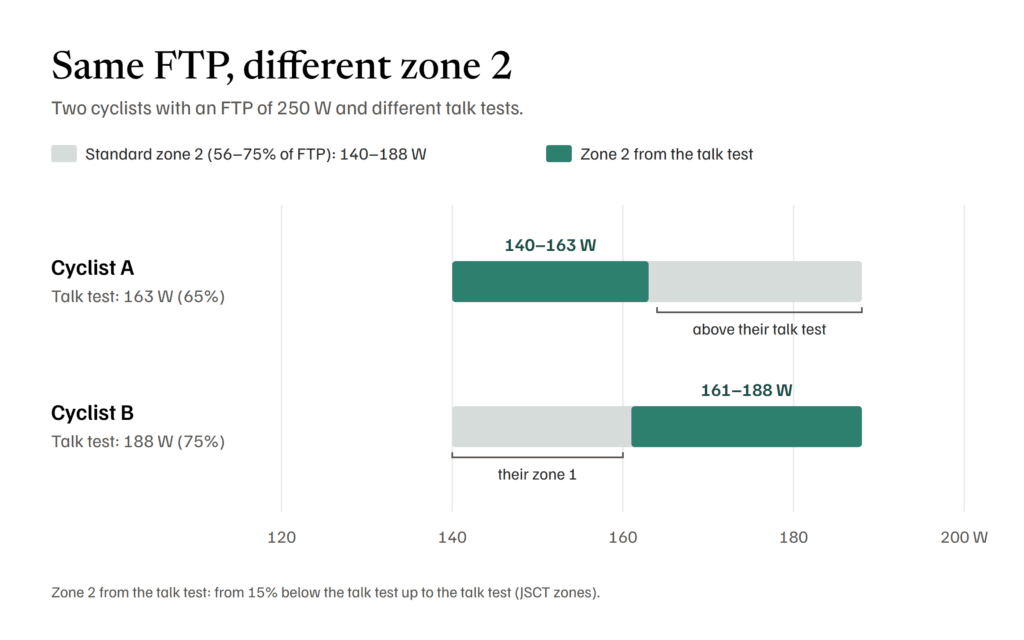
Imagine two cyclists with the same FTP, 250 W. With the standard zone 2, both would ride between 140 and 188 W. But cyclist A’s talk test is at 65% of FTP (163 W) and cyclist B’s at 75% (188 W):
- For cyclist A, the top of the standard zone 2, from 164 to 188 W, is already above their talk test, which is the ceiling of their zone 2. They think they’re doing an easy ride and spend a good part of it in zone 3, with more fatigue than they were after.
- For cyclist B, the ceiling matches, but the standard zone starts too low: from 140 to 160 W is their zone 1. Riding in the lower part of the standard zone, they stay below the stimulus they could sustain with little fatigue.
Heart rate has a similar problem. The default zones on many watches come from a percentage of maximum heart rate, which often hasn’t even been measured: formulas such as “220 minus age” can be off by ten beats or more. A study of 50 experienced cyclists compared different ways of defining zone 2 and concluded that fixed percentages, such as a percentage of maximum heart rate, are practical but may not reflect each cyclist’s metabolic response well [3].
The solution is to anchor zone 2 to your first threshold, not to a percentage. The most accurate way to measure it is a lactate test or a gas exchange test. The simplest is the talk test.
The talk test: what it is and why it works
The talk test consists of riding at increasing intensities and checking, at the end of each step, whether you can still talk comfortably. It seems too simple to work, but it has a clear physiological basis: above the first threshold, breathing speeds up faster than oxygen uptake, and talking continuously starts to get hard.
Studies comparing it with gas exchange testing confirm this. The point where talking starts to get hard coincides almost exactly with the first ventilatory threshold, and when you can no longer talk comfortably you’re above it [4]. The same has been seen in highly trained cyclists: the step where you start to hesitate coincides with the first threshold, and the step where you can no longer talk, with the second [5].
That’s why the last step where you can still talk comfortably sits just below the first threshold. That’s the upper limit of your zone 2. It isn’t as precise as a lab test, but it’s free, you can repeat it whenever you want and, done well, it gives you a limit that’s far more your own than any percentage.
How to do the talk test, step by step
Ideally, do it on the indoor trainer in ERG mode, so the power of each step stays steady. A long flat road with no traffic or wind also works. Do it rested, with no hard session the day before, and prepare a short text you know by heart, about 30 words long.
- Start at 55% of your FTP, in zone 1, and go up one step every 6 minutes: 55, 60, 65, 70, 75 and 80% of FTP. Long steps give your breathing and heart rate time to settle at each power.
- At the end of each step, say the text out loud and ask yourself: could I talk comfortably, without breaking up sentences to breathe? Also note your heart rate and your rating of perceived exertion (RPE) from 1 to 10.
- When you reach a step where you can no longer talk comfortably, stop the test. If you’re unsure on a step, count it as the first one where you’re no longer comfortable.
- Your talk test is the power of the last step where you could still talk comfortably.
These are the steps for an FTP of 250 W:
| Step (6 minutes) | % of FTP | With an FTP of 250 W |
|---|---|---|
| 1 | 55% | 138 W |
| 2 | 60% | 150 W |
| 3 | 65% | 163 W |
| 4 | 70% | 175 W |
| 5 | 75% | 188 W |
| 6 | 80% | 200 W |
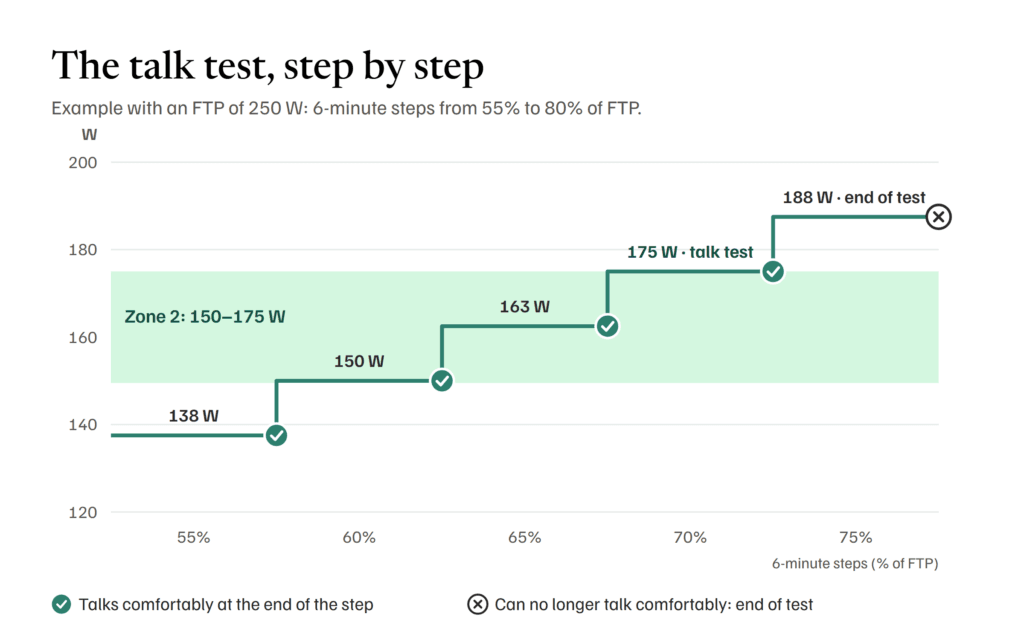
In the example, the cyclist talks comfortably up to the 70% step (175 W). At 75% it gets hard, so the test ends there and their talk test is 175 W. There are six steps at most, so the test never lasts more than 36 minutes.
Repeat it every 8 weeks, after a training block or when you notice the same power feels different.
From the talk test to your zones
The talk test marks the upper limit of zone 2. In JSCT zones, zone 2 runs from 15% below the talk test up to the talk test, and everything below that is zone 1. In the example above, with an FTP of 250 W and a talk test of 175 W:
- Zone 1: up to 149 W.
- Zone 2: 150 to 175 W.
- Zone 3: 176 to 225 W (90% of FTP).
The upper zones are set with your FTP and your power profile. You can calculate them all with the training zones calculator: enter your FTP, your talk test and your best 5-minute and 20-second power, and it gives you the 7 zones in watts and as a percentage of FTP, ready to copy. If you use Intervals.icu, in the complete guide to Intervals.icu I explain where to set your FTP and zones.
The heart rate and perceived exertion you noted on the last comfortable step are useful too: they tell you what the ceiling of your zone 2 costs you. On long rides, especially in the heat, heart rate rises even if you hold the same power [6], so don’t expect it to always match the test. That’s why it’s worth watching all three references at once: watts tell you what you’re doing; heart rate and perceived exertion, what it costs you.
Perceived exertion (RPE) is a very useful reference if you know how to use it, and the way to learn is to always write it down, in the talk test and in every session. Over time, you’ll be able to recognise the ceiling of your zone 2 without looking at a screen.
Talk test, heart rate or lactate test
| Method | What it gives you | Pros | Cons |
|---|---|---|---|
| Percentage of FTP or maximum heart rate | An average zone | Instant, no testing | Doesn’t know where your threshold is |
| Talk test | An estimate of your first threshold | Free, simple and repeatable | Depends on doing it well and answering honestly |
| Lactate test | Your lactate curve and measured thresholds | The most precise of the three | Needs a test with specific equipment |
For most cyclists, the talk test is a much better starting point than a percentage. If you’re preparing specific goals or want to fine-tune further, a lactate test measures your thresholds directly and shows how your metabolism responds to each intensity.
How much zone 2 to do
It depends on your hours, your goal and how you respond. If you train a lot of hours, most of the volume will be zone 1 and zone 2. If you’re short on time, it’s worth combining it with higher-intensity work, because every hour counts for more.
In practice, zone 2 training fits best in long, steady rides, where the goal is to add time without adding fatigue. Some signs you’re doing it right:
- you finish feeling you could keep going for a good while longer;
- your perceived exertion stays low throughout the ride;
- at the same power, your heart rate rises slowly, without spiking;
- the next day you can train normally.
How much zone 2 suits you, and how to combine it with the rest of the week, is a planning decision. It’s exactly the kind of adjustment I make in my training plans: based on your real hours, your data and your response.
Common zone 2 mistakes
- Going harder than you should. It’s the most common mistake. A “high” zone 2 that is really zone 3 brings more fatigue and not the stimulus you were after.
- Not controlling the climbs. On rolling terrain, every short climb takes you out of the zone. Use easier gears and watch your power, not your speed.
- Trusting default zones. Your watch’s zones, or those from a fixed percentage, may have nothing to do with your threshold.
- Only looking at watts. Power tells you what you’re doing, not what it costs you. If at the same power your heart rate or perceived exertion is higher than usual, because of heat, fatigue, poor sleep or dehydration, that zone 2 is costing you more than it seems and it’s worth easing off.
- Not updating your zones. If your fitness changes and your zones don’t, you’re training with references that are no longer yours.
- Doing only zone 2 when time is short. With few hours, intensity matters more. Zone 2 is the base, not the whole plan.
Frequently asked questions
How much zone 2 should I do each week?
There’s no universal figure: it depends on your hours and your goal. With a lot of volume, most of it will be zone 1 and zone 2. With little, it’s worth combining it with intensity.
Is it better to ride zone 2 by power or by heart rate?
It’s best to combine them and add perceived exertion. If you have a power meter, power is the main reference: it responds instantly and tells you what you’re doing. Heart rate and perceived exertion tell you what it costs you. If they’re higher than usual at the same power, something else is going on, such as heat, fatigue or dehydration, and it’s worth easing off.
Why does my heart rate rise in zone 2 if I hold the same power?
It’s cardiovascular drift. As the hours go by, and especially in the heat or when you’re dehydrated, your heart beats faster to sustain the same effort [6]. Some drift is normal on long rides. If your heart rate rises a lot at the same power, the real effort is going up and it’s worth easing off.
Does zone 2 help you burn fat?
At intensities like zone 2, a large share of the energy comes from fat, and training there improves your ability to use it. But for weight loss, what counts is your energy balance over the week, not the zone you train in.
How often should I repeat the talk test?
Every 8 weeks, or after a training block or a clear change in fitness.
Zone 2 is only as good as its limit
Zone 2 is one of the most useful tools in endurance training, but only if its limit is set right. A percentage gives you an average; the talk test gives you your threshold. And a few watts separate a ride that builds your base from one that leaves you more tired than you think.
If you want to get started, do the talk test in your next indoor session and calculate your zones with the zones calculator. And if you’d like your zones, and how to use them, to be part of a plan built around you, you can get in touch here.
References
[1] Seiler S. What is best practice for training intensity and duration distribution in endurance athletes? Int J Sports Physiol Perform. 2010;5(3):276-291.
[2] Storoschuk KL, Moran-MacDonald A, Gibala MJ, Gurd BJ. Much Ado About Zone 2: A Narrative Review Assessing the Efficacy of Zone 2 Training for Improving Mitochondrial Capacity and Cardiorespiratory Fitness in the General Population. Sports Med. 2025;55(7):1289-1300.
[3] Meixner B, Filipas L, Holmberg HC, Sperlich B. Zone 2 Intensity: A Critical Comparison of Individual Variability in Different Submaximal Exercise Intensity Boundaries. Transl Sports Med. 2025;2025:2008291.
[4] Persinger R, Foster C, Gibson M, Fater DC, Porcari JP. Consistency of the talk test for exercise prescription. Med Sci Sports Exerc. 2004;36(9):1632-1636.
[5] Rodríguez-Marroyo JA, Villa JG, García-López J, Foster C. Relationship between the talk test and ventilatory thresholds in well-trained cyclists. J Strength Cond Res. 2013;27(7):1942-1949.
[6] Coyle EF, González-Alonso J. Cardiovascular drift during prolonged exercise: new perspectives. Exerc Sport Sci Rev. 2001;29(2):88-92.