Introduction: why eat during exercise?
Skeletal muscle uses glycogen and glucose as its main fuel source during high‑intensity efforts. Internal stores are limited (approximately 300–400 g in muscle and 80–100 g in liver) and during a prolonged endurance event they can be depleted within 60–90 minutes. Ingesting exogenous CHO delays hepatic glycogen depletion, stabilises blood glucose and reduces perceived effort. Early research showed that consuming 16 g of glucose every 20 minutes (≈48 g/h) increased endurance capacity by 14 % compared with water. Later it was observed that small amounts (20 g/h) already provided improvements, but performance continued to increase until the limits of intestinal absorption were reached[1]. Because of this high carbohydrate expenditure, nutrition in cycling is key to performing at your best.
Theoretical background: from 60 to 90 g/h and the role of carbohydrate mixes
60 g/h: the limit of a single transporter
Monosaccharides are absorbed via specific transporters: glucose uses the SGLT1 transporter and fructose uses GLUT5. When only glucose is ingested, exogenous oxidation rates reach a maximum of around 60 g/h. This value has marked the recommendation for 2–3 hour efforts for decades. In addition, studies using 6–8 % solutions (≈30–60 g/h) showed consistent improvements in team and power trials[1].
90 g/h: multiple transporters and oxidation
When glucose and fructose are combined in a 2:1 ratio, both transporters are utilised, allowing oxidation up to 105 g/h—about 75 % higher than that achieved with a single carbohydrate. This increase in oxidation translates into perceptual benefits: cyclists consuming glucose–fructose beverages improved their power output by 9 % and experienced less fatigue than with glucose alone. For this reason most current guidelines set the “bar” at 90 g/h for events lasting > 2.5 hours, using CHO mixes in gels, drinks or bars[1].
Recent evidence: is 120 g/h better?
Ultratrail studies comparing 60 vs 90 vs 120 g/h
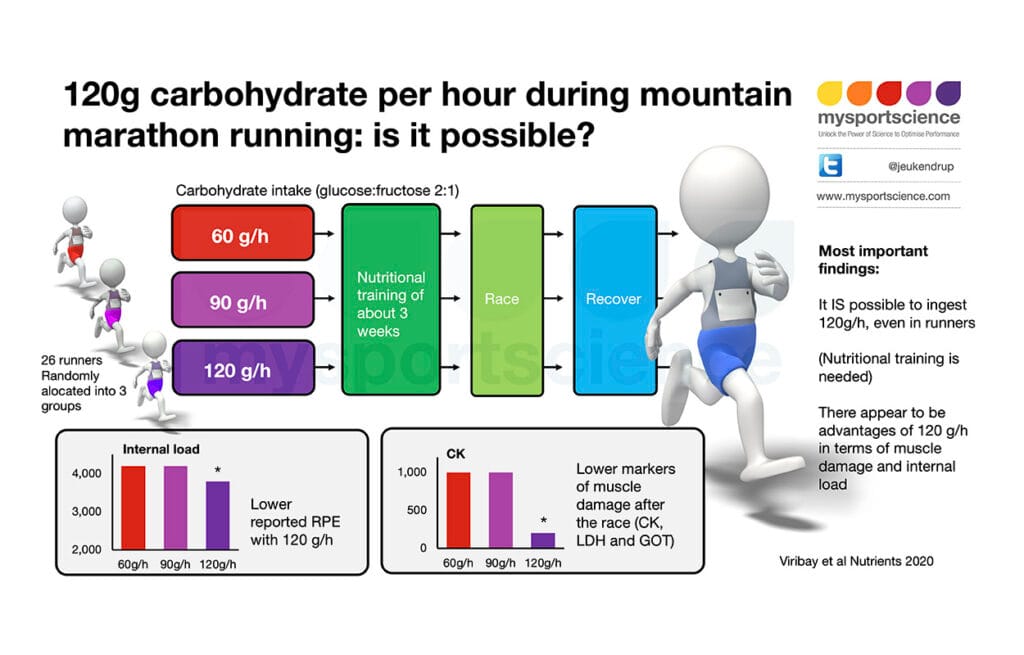
In 2020 Viribay and colleagues conducted a pioneering study with 26 elite mountain runners, comparing intakes of 60 g/h, 90 g/h and 120 g/h during a mountain marathon with 4,000 m of elevation gain. Participants were trained to tolerate these intakes. The results showed that the 120 g/h group had significantly lower CK, LDH and GOT values (markers of muscle damage) 24 h post‑race than the 60 and 90 g/h groups. In addition, the internal exercise load calculated from perceived effort and duration was lower in the 120 g/h group[2, 3].
Another study in the same year (Urdampilleta et al.) analysed neuromuscular and internal load parameters in a similar trail. Runners who consumed 120 g/h maintained their jump capacity (Abalakov and half‑squat tests) after the race, whereas the 90 g/h and 60 g/h groups showed significant declines. Maximal heart rate and perceived exertion (BORG) were maintained in the 120 g/h group but decreased in the lower‑intake groups. Finally, internal load measured via TRIMP was about 315 AU in the high‑intake group versus 371 AU and 400 AU in the 90 g/h and 60 g/h groups, respectively[4]. These data imply a 15–25 % reduction in physiological load with a 120 g/h intake.
Why does 120 g/h work?
Exceeding 90 g/h is only possible when multiple transporters are used (2:1 or even 1:0.8 glucose:fructose) and the athlete has trained their digestive system. The studies above show that high intake not only improves performance on race day but also recovery and muscle damage. A possible mechanism is that a larger exogenous supply spares hepatic glycogen and reduces protein breakdown. In addition, by maintaining stable blood glucose, perceived effort and cardiovascular load decrease.
Physiological explanation: transporters, limits and gut training
- Oxidation limits: as noted, glucose oxidation saturates around 60 g/h. Fructose uses a different transporter, so combining the two increases the carbohydrate flux into the plasma up to ≈105 g/h[1].
- Gut training: the intestine is adaptable. A three‑week protocol gradually increasing carbohydrate intake (for example, from 60 to 75–90 g/h) can accelerate gastric emptying, improve absorption and reduce gastrointestinal problems. Research led by Asker Jeukendrup shows that improvements in oxidation and tolerance occur within just 2–3 weeks[5].
- Individual variability: although some elite athletes have tolerated up to 180 g/h, others experience discomfort with 90 g/h. Therefore gut training and individualised tests (e.g. carbon‑13 oxidation testing) are key to determining personal limits.
Carbohydrate intake recommendations by duration
| Situation/duration | CHO recommendation | Notes |
| < 1 h | 30–60 g/h | Increases performance and maintains blood glucose; at this duration glycogen is not depleted but the nervous system still benefits[1]. |
| 2.5 h or longer (endurance) | ≈ 90 g/h (2:1 glucose:fructose) | The traditional ceiling to avoid saturating transporters; use drinks and gels containing glucose and fructose[1]. |
| Ultra‑endurance with gut training | 90–120 g/h | Can reduce internal load by ~20 % and markers of muscle damage 24 h later[3]; requires prior digestive training. |
Other important points: add sodium (400–700 mg/h); individualise according to tolerance; never try anything new in competition; and consider an oxidation test for high‑level athletes.
Example nutrition plans for races
Below are sample plans using products from the Maurten brand to standardise quantities (gels, drinks and bars). Adjust brands and amounts according to your tolerance and preferences.
1h 30min race
Goal: maintain high glycogen stores without overloading the digestive system.
Recommendation: 30–60 g/h of fast‑acting CHO, totalling 45–90 g.
Practical example:
- Pre‑start: 1 Gel 100 CAF 100 (25 g CHO + 100 mg caffeine)
- Minute 40: 1 Gel 100 (25 g CHO)
- Hydration: water or a low‑CHO isotonic drink depending on temperature
- Total CHO: ≈50 g (33 g/h)
3h race
Goal: avoid glycogen depletion and central fatigue.
Recommendation: 60–90 g/h using a 1:0.8 glucose:fructose mix; total 180–270 g over the entire event.
Practical example:
- Pre‑start: 1 Gel 100 or 1 Solid 225 bar (25–44 g)
- 0–1 h: 1 Drink Mix 320 (80 g)
- 45 min: 1 Gel 100 CAF 100 (25 g + 100 mg caffeine)
- 1–2 h: 1 Solid 225 bar (44 g)
- 2–3 h: 1 Drink Mix 160 (40 g) + 1 Gel 100 (25 g)
- Total CHO: 214–239 g, i.e. 71–80 g/h
6h race (ultra)
Goal: maintain energy substrates, protect muscle and avoid the “bonk”.
Recommendation: 90–120 g/h only for athletes who have trained for it. Total 540–720 g.
Practical example:
- Pre‑start: 1 Solid 225 bar (44 g)
- 0–1 h: 1 Drink Mix 320 (80 g) + 1 Gel 100 (25 g)
- 1–2 h: 1 Solid 225 bar (44 g)
- 2–3 h: 1 Drink Mix 320 (80 g) + 1 Gel 160 (40 g)
- 3 h: 1 Gel 100 CAF 100 (25 g + 100 mg caffeine)
- 3–4 h: 1 Drink Mix 320 (80 g) + 1 Solid 225 bar (44 g)
- 4–5 h: 1 Drink Mix 320 (80 g) + 1 Gel 160 (40 g)
- 5–6 h: 1 Solid 225 bar (44 g)
- Total CHO: ≈582 g (≈97 g/h)
Complementary strategies
The focus should be on everything discussed above, as that is what will make the difference; however, there are some nutritional strategies that can give you a small extra boost.
Gut training
This has already been introduced, but we think it is important to reiterate it. Like any tissue, the digestive system adapts to stimuli. A 2–3 week protocol with 2–3 sessions per week of “gut training” gradually increasing CHO intake (60→75→90→120 g/h) improves gastric emptying, absorption and reduces gastrointestinal problems[5]. Jeukendrup’s research shows improvements in oxidation and tolerance in just 2–3 weeks[5]. If you want to try it, I recommend increasing intake by 5–10 g/h per week and testing the same drinks and gels you’ll use in competition. Also try combining high‑CHO drinks with salt‑only drinks or water when it’s hot, and add some solid food as well.
Carb mouth rinse
In efforts of 30–75 minutes it has been observed that rinsing the mouth with a 6–8 % CHO solution for 8–10 seconds without swallowing can improve performance by 2–3 %【[6]. The mechanism is neurological: oral receptors stimulate brain areas related to motivation. It is useful in time trials, final sprints or situations where swallowing a gel is uncomfortable.
Carbon‑13 oxidation testing
Some laboratories offer tests in which CHO labelled with isotopes are ingested and the expired air is analysed to determine the maximal oxidation capacity. This allows intake to be personalised: some professional athletes tolerate 130–180 g/h, whereas others do not exceed 90 g/h. It is an advanced tool, recommended for athletes with the resources to optimise their strategy.
Front‑loading CHO
Consuming 30–60 g of CHO in the minutes before the start (e.g. a caffeinated gel during warm‑up) raises plasma concentrations and can improve the explosive start or the first changes of pace. Although evidence is limited, in explosive events or those with a steep climb at the beginning it can make a difference. It does not replace the overall strategy and should always be rehearsed in training.
Timing is crucial: if you take 30–60 g about 30 minutes before the start and/or without having warmed up, it can be counterproductive because it may lead to reactive hypoglycaemia. This reactive hypoglycaemia is the body’s normal carbohydrate absorption process but causes an acute drop in plasma glucose (lasting a few minutes). From a performance standpoint this is undesirable, as you would feel weak right from the start. Therefore, if doing front‑loading, aim to consume CHO just before the start and after warming up.
Conclusions
- Minimum effective dose: for events < 2 hours, 30–60 g/h of fast carbohydrate is sufficient to improve performance and maintain blood glucose.
- Classic endurance: in races lasting ≥ 2.5 h, combining glucose and fructose up to 90 g/h maximises oxidation (about 75 % higher than with glucose alone) and improves power by 9 %.
- Ultra‑endurance: recent studies show that 120 g/h (with properly trained stomach) reduces internal load by 15–25 %, decreases muscle damage markers 24 h post‑race and preserves neuromuscular function.
- Individualise: gut training allows higher intakes and must be practised weeks in advance; some athletes can reach 180 g/h while others do not exceed 90 g/h.
Internal and external link building
To delve into training planning and how to integrate it with nutrition, check out our cycling training plan and, if you’re looking for personalised guidance, contact our cycling coach. We also recommend reading articles like Asker Jeukendrup’s piece on 120 g/h in mountain marathons or this summary on gut training in 3 weeks, cited in the article for a deeper look into this topic.
Bibliography
1. Jeukendrup AE. A Step Towards Personalized Sports Nutrition: Carbohydrate Intake During Exercise. Nutrients. Disponible en: https://pmc.ncbi.nlm.nih.gov/articles/PMC4008807/
2. Viribay A., et al. Effects of 120 g/h of carbohydrates intake during a mountain marathon. Nutrients. 2020. Disponible en: https://pubmed.ncbi.nlm.nih.gov/32403259/
3. Jeukendrup A. 120 grams of carbohydrate per hour in mountain marathon runners. MySportScience; 2020. Disponible en: https://www.mysportscience.com/post/120-grams-per-hour
4. Urdampilleta A, et al. Effects of 120 vs. 60 and 90 g/h Carbohydrate Intake during a Trail Marathon on Neuromuscular Function and High-Intensity Run Capacity Recovery. Nutrients; 2020. Disponible en: https://pmc.ncbi.nlm.nih.gov/articles/PMC7400827/#sec3-nutrients-12-02094
5. Gut Training for Cycling, Running & Endurance Events — Endurance Kollective. Disponible en: https://endurancekollective.co/sv/blogs/tips-och-rad-sv/gut-training-in-3-weeks-improve-carbohydrate-tolerance-before-race-day
6. Carbohydrate mouth rinsing. Wikipedia. Disponible en: https://en.wikipedia.org/wiki/Carbohydrate_mouth_rinsing