Table of Contents
Benefits of strength training in cycling
Improved aerobic and anaerobic performance. A 10–12 week heavy program of strength training for cycling improved pedalling economy and increased 5-min test performance by 7% in well-trained cyclists [1]. Improvements were also observed in a 40-min time trial and in maximal power in 30-s efforts [2].
More power without gaining weight. In studies by Rønnestad and colleagues, cyclists continued riding and adjusted their diet; this allowed increases in strength and power without increasing body mass [2].
Fatigue resistance and durability. Maintaining one strength session per week for 13 weeks preserved increases in thigh cross-sectional area and produced improvements in power at 2 mmol lactate, in the 40-min time trial, and in 30-s peak power [3]. In other words, strength enhances the “fatigue resistance” that separates riders who finish a stage fresh from those who blow up on the final climb.
Bone health and injury prevention. Cycling is a low-impact sport; research in master cyclists shows bone mineral density is significantly lower than in sedentary individuals of the same age and weight, with a 60% prevalence of osteopenia and a seven-fold higher risk than in runners. Strength training provides mechanical loading that increases bone mineral density in the lumbar spine and hip and helps preserve bone health. In addition, a meta-analysis of 25 randomized controlled trials found that strength training reduces sports injuries to less than one third (RR 0.315) and that overuse injuries are reduced by almost half [5].
Muscle function and healthy aging. From the age of 30, muscle mass and strength decline by approximately 3% to 8% per decade, and this loss accelerates after age 60; strength training helps maintain physical function and tolerate higher training loads [6].
Reduced pain and joint overload. Training the core and upper body improves trunk stability, delays the onset of fatigue during climbs and sprints, and may reduce stress at the knee; some studies suggest core fatigue alters pedalling biomechanics and increases joint stress, so strengthening these areas could help mitigate pain [7].
When and how often should you train it?
The ideal time to start a strength block is the cycling off-season or base period, when bike intensity is low or moderate. Surveys in professional UCI cyclists indicate that during the off-season they typically perform two strength sessions per week. If you haven’t lifted for months, avoid starting during high-intensity phases because accumulated stress could be excessive.
The literature suggests that two weekly heavy strength sessions for 8–12 weeks are enough to improve pedalling economy and power in cyclists. If strength training is stopped for more than eight weeks, adaptations tend to disappear, but they can be maintained with a single session every 7–10 days. To optimize recovery, avoid scheduling heavy strength sessions on consecutive days or right before hard bike workouts; leave at least 24 hours between a heavy strength session and a demanding ride.
During the competitive season, one weekly session with lower volume (e.g., 2 sets of 5 reps of squat or unilateral leg press and 1 set of 6 reps of hip flexion and plantar flexion) is enough to maintain strength and muscle mass [3]. Dropping strength work when the season starts leads to a gradual loss of gains and a decrease in race power.
How to train it: basic principles
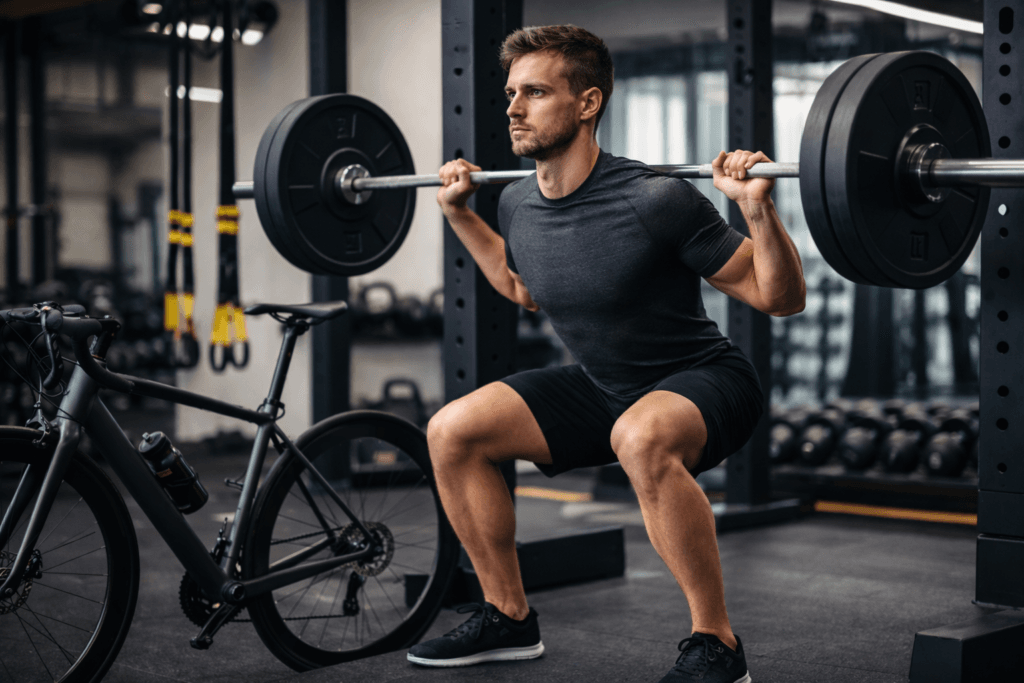
Specificity. Exercises should reproduce the pedalling pattern. Bench press won’t help a road cyclist. In contrast, movements such as squats, lunges, Bulgarian split squats, step-ups, or hip thrusts mimic knee and hip extension when pedalling. Rønnestad’s studies use half squats, unilateral leg press, standing hip flexion, and plantar flexion [2].
Variety and bilateral balance. Better to do 2 sets of two different exercises than 4 sets of the same one. Alternating bilateral exercises (barbell squat) with unilateral ones (lunges or step-ups) helps correct asymmetries and trains stabilizing muscles.
Progressive overload. In trials, the first weeks use higher reps (10RM–6RM) and progressively reduce to 4RM [2]. The principle is clear: once the body adapts, you must increase load or reduce reps to keep the stimulus effective.
Core activation. Doing front and side planks, bird-dog, dead bug, or anti-rotation exercises in the warm-up improves trunk stability and force transfer to the pedals. A strong core reduces low-back fatigue and may mitigate knee overload; the literature suggests core fatigue alters pedalling biomechanics and increases joint stress [7].
Maintenance. The maintenance phase is just as important as the development phase. Without a minimal stimulus, improvements fade within weeks. Adaptations achieved during development can be maintained with one weekly strength session; studies in cyclists suggest one session every 7–10 days is enough to preserve strength and muscle mass [7].
Don’t overload rest days. Keep at least one no-load day per week to allow recovery; if you only have one or two free days, don’t use them for heavy lifting.
Recommended exercises for cyclists
The studies mentioned focus on multi-joint movements involving large muscle groups. Below are the most useful exercises, organized by musculature:
| Muscle group | Suggested exercises |
|---|---|
| Anterior chain (quadriceps and hip) | Back squat, front squat, Bulgarian split squat, forward lunge, high step-up |
| Posterior chain (glutes and hamstrings) | Hip thrust, barbell glute bridge, Romanian deadlift, conventional deadlift, kettlebell swing |
| Hip and ankle flexors | Hip flexion with band/cable, unilateral leg press, calf raises |
| Core | Front and side plank, bird-dog, dead bug, Pallof press, farmer’s walk |
| Upper body | Barbell or dumbbell row, pull-ups or lat pulldown, overhead press – included to compensate for the lack of upper-body loading and prevent muscular imbalances |
For road cyclists, it is essential to include at least one posterior-chain exercise, one anterior-chain exercise, and one hip/ankle flexor exercise. At JS Cycling Training, to get the biggest benefits with the least time invested, we recommend two anterior-chain exercises (one bilateral like the squat and one unilateral like the Bulgarian split squat), one posterior-chain exercise (like the hip thrust), and one calf-raise exercise.
For mountain biking or gravel, it’s recommended to add a couple of upper-body exercises. In this case, stability drills, jumps, lateral jumps, or eccentric calf work can also be used to improve impact absorption and reduce injury risk, although these become a secondary priority.
If you want to read an article about the methodology we use for exercise execution and training loads (velocity-based strength training), click here.
Session organization
- Specific warm-up. 10 min of joint mobility, core activations, and dynamic exercises (planks, bridges, bodyweight squats). Once finished, do one or two lighter sets of the first main lift, then move to your working load.
- Main bilateral lift. 3 sets of 4–6 reps of heavy squat or deadlift. Rest 2 min between sets.
- Unilateral exercise. 3 sets of 6–8 reps per leg (lunge, Bulgarian split squat, or step-up). Rest 2 min.
- Accessories. Two lighter exercises (hip thrust, unilateral leg press, calf raises) for 2 sets of 8–10 reps.
- Core work. 5–10 min of planks, anti-rotation, and lumbar stability.
In development periods (pre-season), intensity should be high and concentric speed maximal: lift in 1 s and lower in 2–3 s. In competition, reduce volume and keep intensity to maintain strength without adding fatigue. A good weekly guideline is: two strength sessions per week in pre-season or early planning phases, and once the competition phase starts, shift to one day per week.
Bibliography
[1] Rønnestad, B.R., Hansen, E.A. & Raastad, T. Strength training improves 5-min all-out performance following 185 min of cycling.
[2] Rønnestad, B.R., Hansen, E.A. & Raastad, T. Effect of heavy strength training on performance determinants and 40-min time trial performance in well-trained cyclists.
[3] Vikmoen, O., Ellefsen, S. & Rønnestad, B.R. In-season strength maintenance training increases well-trained cyclists’ performance.
[4] Vikestad, V., Dalen, T. & col. Strength training among male master cyclists—practices, challenges and rationales.
[5] Lauersen, J.B., Andersen, L.B. & Bertelsen, D.M. The effectiveness of exercise interventions to prevent sports injuries: a systematic review and meta-analysis of randomised controlled trials.
[6] Narici, M.V., & Maffulli, N. Muscle tissue changes with aging.
[7] Vikestad, V., Lyngstad, I.K., & Dalen, T. Strength training among professional UCI road cyclists: practices, challenges and rationales.