Tabla de contenidos
Table of Contents
Introduction
Structured training, power control, and nutritional planning are the pillars of cycling performance. However, to be a complete cyclist, it’s not enough to accumulate kilometers. The prolonged posture on the bike, the training volume required to improve in endurance events, and the high carbohydrate consumption demand proper attention to strength, bone health, nutrition, and oral care. Ignoring these weak points can impair performance in the medium term and even shorten a sporting career. The following is a critical analysis of the main deficits and weak points of cycling, along with evidence-based solutions.
Main Weak Points of Cycling and How to Compensate for Them
| Weak Point | Main Effect | Key Solution |
|---|---|---|
| Time and balance | Stress, lack of recovery | Precise planning, HIIT, recovery weeks |
| Muscular imbalance | Lower back pain, injuries | Strength 2–3x/week, mobility, technical supervision |
| Rounded posture | Thoracic stiffness, reduced respiratory capacity | Back exercises, stretching, diaphragmatic breathing |
| Low bone density | Risk of osteopenia | Strength training, impact work, vitamin D |
| Nutritional deficits | Fatigue, muscle loss | Dietary plan, blood tests, controlled supplementation |
| Oral health | Cavities, dental erosion | Post-training hygiene, biannual check-ups |
| Mental fatigue | Demotivation, overtraining | Mental rest, variety, planned disconnection |
1. Required Time and Balance
Problem: Cycling is one of the endurance sports that requires the most training hours. An amateur preparing for 150–200 km sportives typically dedicates between 8 and 12 hours per week, about 50 % more time than those who practice running or weight training. In competitive categories, exceeding 15 h per week is common. Maintaining this volume can compromise family and work life and leave little room for other hobbies or recovery.
Solutions:
- Plan precisely: Schedule long rides for weekends and use indoor training or smart trainers during the week to optimize time. A 90-minute indoor session can provide almost the same aerobic stimulus as a 2-hour ride on the road thanks to the absence of stops.
- High-intensity training: Incorporating 30–60-minute HIIT sessions can maintain fitness with 20–30 % less total training volume. Research comparing traditional periodization with mixed approaches suggests that combining two HIIT sessions with one long ride maintains or even improves VO₂max in trained cyclists[1].
- Delegate and seek support: Agreeing on fixed training times with your partner or family helps minimize the impact of saddle hours. Alternating high-volume and recovery weeks is also advisable.
2. Muscular Imbalance and Injuries
Problem: The biomechanics of pedaling emphasize the quadriceps, hip flexors (psoas), and lower back muscles, while the gluteus maximus, hamstrings, and core play a secondary role. Over time, this leads to muscular imbalances and shortening, increasing injury risk. A cross-sectional study of 1,274 amateur Italian cyclists found that 55.1 % had experienced lower back pain at some point, 26.5 % within the past year, and 10.8 % in the last four weeks[2]. Among professional cyclists, annual prevalence approaches 58 %, a higher rate than in the general population[2].
Solutions:
- Structural strength training: Including 1–2 weekly strength sessions reduces injury incidence. Strengthening glutes, hamstrings, and core improves lumbopelvic stability and pedaling efficiency. Studies show that cyclists who perform strength training year-round have 15–20 % fewer injuries than those who only ride.
- Stretching and mobility: Spending 10–15 minutes a day on stretches targeting the psoas, quadriceps, and lower back helps prevent shortening. Joint mobility work (hips and thoracic spine) improves efficiency and reduces stiffness.
- Technical supervision: Following a structured plan under professional supervision reduces injury risk. The cited study found that being coached reduced the likelihood of lower back pain by about 47 %[2].
3. Postural Imbalance of the Upper Trunk
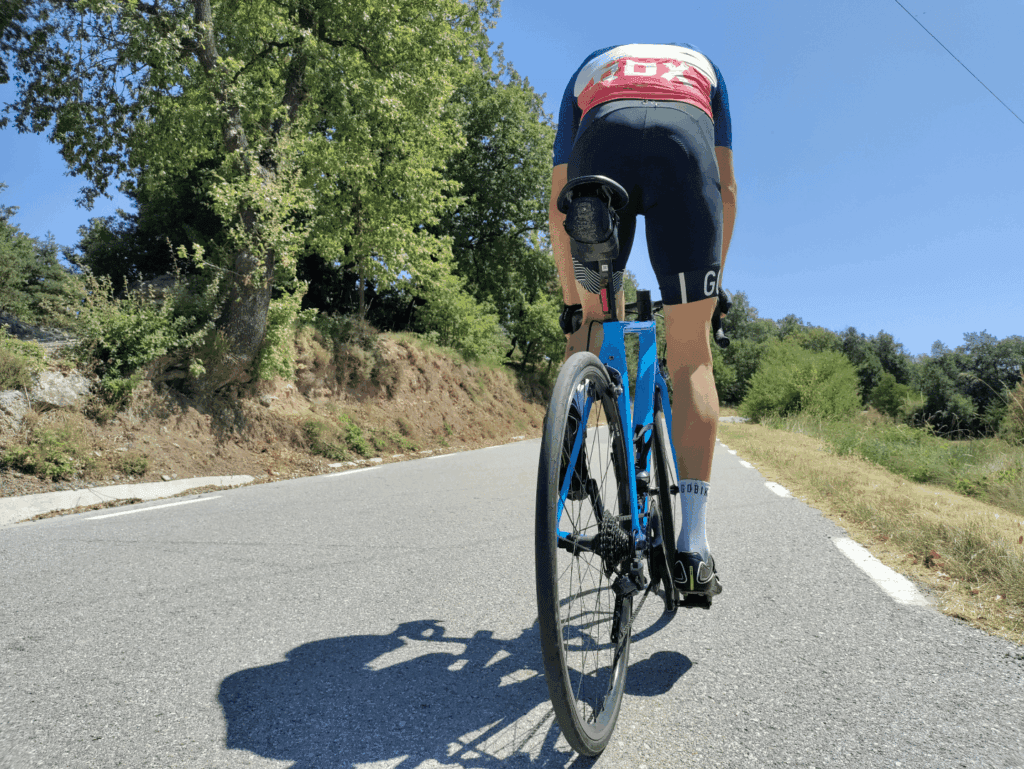
Problem: Spending hours with the thoracic spine in kyphosis and the shoulders rounded forward causes stiffness in the upper back, weakness in the rhomboids and lower trapezius, and shortening of the pectorals. This reduces thoracic mobility by roughly 15–20 % and is associated with neck or lower-back pain in over 50 % of endurance cyclists. Poor posture also impairs respiratory capacity and limits sustained power output.
Solutions:
- Strengthen the upper back: Exercises such as inverted rows, face pulls, and scapular retractions activate the rhomboids and lower trapezius. Incorporating 2–3 sets of 12–15 repetitions twice per week improves posture and the ability to maintain aerodynamic positions.
- Stretch the pectorals: Stretching the pectoralis major and minor against a doorway or corner for 30–60 s helps open the chest. Complement this with thoracic spine mobility work using foam rollers.
- Respiratory work: Diaphragmatic breathing exercises and inspiratory muscle training can increase maximal inspiratory strength by 10–15 % within a few weeks, compensating for the rounded posture.
4. Low Bone Density
Problem: Cycling is a non-impact sport; body weight is supported by the saddle and pedals. Over time, this lack of impact combined with low-energy diets can decrease bone mineral density (BMD), particularly in the lumbar spine and femoral neck. A study of 19 elite Norwegian cyclists found that 10 of them (53 %) had low BMD according to the American College of Sports Medicine criteria, despite performing strength training[3]. Cyclists showed lower BMD in all regions compared to endurance runners[3].
Solutions:
- High-load strength training: Working with 70–85 % of 1RM (squats, deadlifts, lunges) stimulates osteogenesis. Studies on endurance athletes show 2–5 % increases in hip bone density after 6–12 months of high-load training.
- Impact activity: Incorporating hiking, light running, or plyometric jump sessions twice a week provides osteogenic stimuli. Even 10 minutes of jump rope can help maintain BMD.
- Nutritional control: Ensure sufficient calcium (~1,000 mg/day) and vitamin D (1,000–2,000 IU/day). Regular blood tests help detect deficiencies; supplementation may be needed in winter.
5. High Caloric Demand and Nutritional Imbalances
Problem: Cycling’s high energy expenditure requires large carbohydrate intake, which can lead to imbalances between energy intake and expenditure. This can cause low energy availability, muscle loss, or micronutrient deficiencies. Research shows that iron deficiency affects 15–35 % of female athletes and 5–11 % of males, leading to premature fatigue and reduced training response[4]. Vitamin D and calcium deficiencies are also common in non-impact sports, compromising bone health.
Solutions:
- Personalized dietary planning: Adjust caloric intake to training volume. Cyclists training 10–12 h per week may need 3,000–4,000 kcal/day, consuming 8–12 g of carbohydrates per kg body weight on load days and 1.6–2.0 g/kg of protein to support recovery.
- Regular blood tests: Check ferritin, vitamin D, B₁₂, and calcium at least once a year. Ferritin levels below 30 µg/L in women or 40 µg/L in men indicate deficiency—adjust diet or supplement accordingly.
- Controlled supplementation: Use iron, vitamin D, or B₁₂ supplements under medical supervision when tests show deficiency. Avoid self-supplementing to prevent toxicity or nutrient absorption issues.
- Attention for vegetarians/vegans: Those following plant-based diets should monitor non-heme iron, calcium, and B₁₂ carefully. Including vitamin C-rich foods during meals improves absorption of plant-based iron.
6. Oral Health
Problem: The frequent consumption of gels, bars, and sports drinks exposes teeth to sugars and acids. Reduced salivation during exercise worsens the effect. A University College London study of 352 Olympic and professional athletes (including cyclists) found that almost half (49.1 %) had untreated cavities, 32 % reported that oral health negatively affected performance, and 87 % used sports drinks while 70 % used gels[5]. Despite 94 % brushing at least twice daily, the sugar-acid combination significantly increased erosion risk[5].
Solutions:
- Hydrate with water or sugar-free drinks: Alternate gels and isotonic drinks with water to dilute sugars and stimulate salivation.
- Post-training hygiene: Brush teeth or rinse with a fluoride mouthwash immediately after training to reduce prolonged sugar exposure. Chewing sugar-free gum with xylitol also stimulates saliva and reduces cavities.
- Less cariogenic products: Choose bars with fewer simple sugars and more nuts or whole grains. Some brands offer gels with neutral pH or complex carbohydrates.
- Dental check-ups: Visit the dentist every six months to detect erosion or cavities early. Sports dentistry professionals can advise on protective products like fluoride varnishes.
7. Mental Fatigue and Motivation
Problem: Excessive performance control and lack of variety can lead to psychological saturation. Studies by Marcora et al. (2009) show that mental fatigue can reduce physical performance by up to 15 % due to increased perceived effort.
Solutions:
- Vary stimuli: Alternate cycling with strength sessions or social rides in different environments.
- Mental breaks: One recovery week every 4–6 weeks reduces burnout. I also recommend an annual break to regain freshness both physiologically and mentally, followed by a transition period with non-cycling workouts that maintain fitness without mental overload.
- Mindfulness/breathing/meditation: These practices not only improve emotional regulation and long-term adherence but can also produce physiological benefits—5–10 minutes of meditation can significantly reduce blood cortisol levels (the stress hormone).
Conclusions
Addressing cycling’s “weak points” is not optional but essential to prolong athletic longevity and optimize performance. Training time must be managed intelligently to avoid family and social conflicts. Regular strength and mobility work compensates for muscular and postural imbalances, reducing lower-back injury rates by 40–50 %. Including impact exercises and monitoring vitamin D and calcium helps maintain bone density and prevent osteopenia. Proper nutritional planning avoids low energy availability and corrects deficiencies such as iron deficiency, which affects up to a third of female athletes. Attention to oral health—often neglected by cyclists—can prevent problems that, as the UCL study shows, already affect one in three athletes’ performance. Finally, incorporating planned mental breaks, breathing or meditation practices, and varied training can improve recovery and long-term consistency. Remember: mental health matters too.
Ultimately, the best watt is the one you can sustain for many years. Being a healthy cyclist is much more than adding up kilometers; it means acting proactively in all these areas to ride stronger and longer.
References
[1] Laursen P. B., & Jenkins D. G. (2002). The scientific basis for high-intensity interval training: Optimising training programmes and maximising performance in highly trained endurance athletes. Sports Medicine, 32(1), 53–73.
[2] Battista S., Sansone L. G., Testa M. (2021). Prevalence, characteristics, association factors of and management strategies for low back pain among Italian amateur cyclists: an observational cross-sectional study. Sports Medicine – Open, 7:78.
[3] Andersen O. K., Clarsen B., Garthe I., Mørland M., Stensrud T. (2018). Bone health in elite Norwegian endurance cyclists and runners: a cross-sectional study. BMJ Open Sport & Exercise Medicine, 4:e000449.
[4] Sim M., Garvican-Lewis L. A., Cox G. R., Govus A., McKay A. K. A., Stellingwerff T., Peeling P. (2019). Iron considerations for the athlete: a narrative review. European Journal of Applied Physiology, 119(7), 1463–1478.
[5] Gallagher J., Needleman I., et al. (2019). Elite athletes have poor oral health despite brushing twice daily. UCL Eastman Dental Institute.
[6] Marcora S. M., Staiano W., & Manning V. (2009). Mental fatigue impairs physical performance in humans. Journal of Applied Physiology, 106(3), 857–864.