
Table of contents
- Why More Training Is Not Always Better Training
- A Coach’s First Job Is to Interpret Your Starting Point
- Training Is the Art of Making Suboptimal Decisions
- From Feedback to Adaptation: Why Information Changes the Way You Train
- It’s Not Just About Practice; It’s About Practicing With Intent
- Having a Coach Is Also a Learning Process
- The Real Value of a Coach
- Bibliography
Why More Training Is Not Always Better Training
In cycling, doing more does not always mean improving more. For a while, accumulating hours can drive progress, especially if you were previously training little or inconsistently. But there comes a point where repeating similar weeks, adding intensity “when you feel like it,” and recovering “when you can” stops producing useful adaptation. That is when stagnation appears, when you feel constantly tired, or when you get the sense that you are training a lot without it really translating into performance.
The problem is usually not a lack of motivation. It is usually a lack of direction. Because training well is not just about adding load. It is about organising that load with purpose, prioritising what is most likely to improve your performance right now, and adjusting the process when reality does not unfold as planned. And that is exactly where a coach adds value.
A coach does not add value simply by “sending workouts.” A coach adds value by turning time into adaptation. By interpreting where you are starting from, identifying what is limiting you, anticipating where you may stall, and designing a process that allows you to keep improving consistently, not just for two or three good weeks.
A Coach’s First Job Is to Interpret Your Starting Point
A generic plan can be well written. An AI can even organise sessions with a certain amount of logic. But neither of those things, on its own, fully understands who you are as an athlete. It does not know how you respond to training load, whether you are carrying fatigue from previous weeks, whether your main limiting factor is VO2max, durability, threshold, strength, tolerance to intensity, or simply your ability to stay consistent over months.
That is where the real work of coaching begins: reading the case. Interpreting your starting characteristics, identifying which levers would move your performance the most right now, and deciding where it makes the most sense to begin. That means accepting an uncomfortable but essential idea: you cannot improve everything at once. In practice, you almost always have to choose. And choosing well is often more important than training more.
When that initial reading is done properly, the plan is no longer just a list of sessions. It becomes a roadmap. One that takes into account your real context, your calendar, your available time, your history, and also your likely sticking points. Because a good coach does not just think about what can improve you today; they think about how you will keep improving in eight, twelve, or twenty weeks without ending up trapped under the same ceiling as always.
Training Is the Art of Making Suboptimal Decisions
There is a very useful way to understand training: as the art of making suboptimal decisions. It sounds odd, but it describes reality quite well. In theory, we would all like to apply the perfect session, at the perfect moment, with the perfect level of freshness. In practice, that scenario almost never exists.
Human performance does not behave like a closed, fully predictable system. It is influenced by sleep and sports performance, work or family stress, diet, accumulated fatigue, health, mood, motivation, expectations, available time, and dozens of small variables that shift from one week to the next. That is why training is less like tuning a Formula 1 car and more like trying to guide a much more complex, more sensitive, and far more chaotic system.
In that context, the right question is usually not “what could I do to improve more?” because the theoretical answer would almost always be to do what a Tour de France rider does: more volume, more recovery, more time to take care of everything, more resources, and more room to put performance at the centre of life. But that is not the useful question for almost anyone. The useful question is different: what can I do to improve as much as possible given my genetics, my availability, my current circumstances, and my goal?
At that point, the problem stops being pure maximisation and becomes optimisation under constraints. It is no longer about chasing an ideal improvement in the abstract. It is about finding the best possible solution within specific conditions, and doing so in a way that is sustainable both physically and psychologically. Because a strategy that looks great on paper but cannot be sustained for months is rarely a good strategy.
In that sense, a very useful way to think about training is to apply the Pareto principle as a practical filter. Not because it is an exact law, but because it forces better prioritisation. Instead of obsessing over 100% of the improvement that might theoretically be possible at any cost, it makes more sense to identify which 20% of actions will get you 80% of the results you can realistically achieve right now. Sometimes that 20% is not adding more intensity. Sometimes it is consolidating two key sessions, sleeping better, arriving fresher for the important work, or sustaining a routine you can repeat week after week.
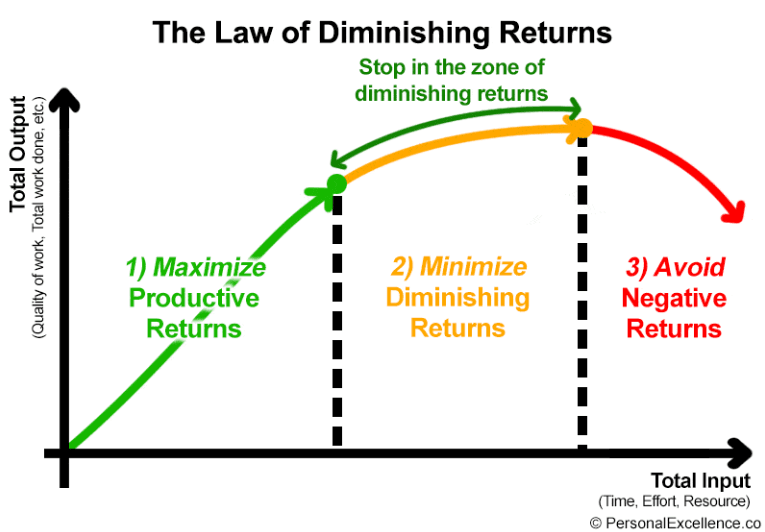
That is why a coach does not always choose the perfect solution. Very often, a coach chooses the best possible solution for that specific case. Or put differently, the least bad option among the available ones and the most cost-effective one within what you can truly sustain. Sometimes that means cutting back so you can arrive with quality for the key session. Sometimes it means trading intensity for useful volume. Sometimes it means accepting that a given week was not the moment to push and that forcing things would only have worsened the adaptation. Far from being improvisation, that decision-making ability is one of the most valuable skills a good coach can have.
That is why the value of a coach is not only in planning when everything is going well. It is, above all, in replanning with sound judgement when reality drifts away from the script. And that happens all the time.
From Feedback to Adaptation: Why Information Changes the Way You Train
One of the reasons a coach can accelerate your improvement is the feedback loop. When you receive clear information about what you are doing, you adjust better, execute with more intent, and make better decisions in the next repetition, the next session, and the next block. That loop between action, information, correction, and new action is a central part of both learning and performance.
At JS Cycling Training, we are strong advocates of velocity-based strength training with an encoder for one very specific reason: it gives you immediate information about execution. You are not just lifting; you know how you are lifting. That information can help you push harder when needed, identify when quality drops, and maintain a clearer target within the session. The evidence points in that direction: instantaneous feedback during strength training has been associated with better acute responses and with a possible improvement in long-term adaptations [1][2].
A coach does not replace an encoder, but often fulfils a similar role at a different level. They act as an external system of reading and interpretation. They help you understand whether that set went as it should, whether your perception matches the data, whether the issue was pacing, accumulated fatigue, or simply context. And that external feedback can change the quality of your training a great deal. Not only because it fine-tunes the plan, but because it makes your execution more precise.
In other words: when you have high-quality feedback, you are not just training to “tick the box.” You are training with a clearer target. And when the target is clear, there is usually more intent, better adjustment, and often better adaptation.
It’s Not Just About Practice; It’s About Practicing With Intent
This is where the idea of deliberate practice fits perfectly. Practice, by itself, is not the most important thing. What matters most is how you practice. For years, a simplified version of the “10,000-hour rule” became popular, as if excellence depended mainly on accumulating time. But that reading falls short. The literature on deliberate practice focuses on something else: specific goals, full attention, immediate feedback, evaluation, and adjustment [3].
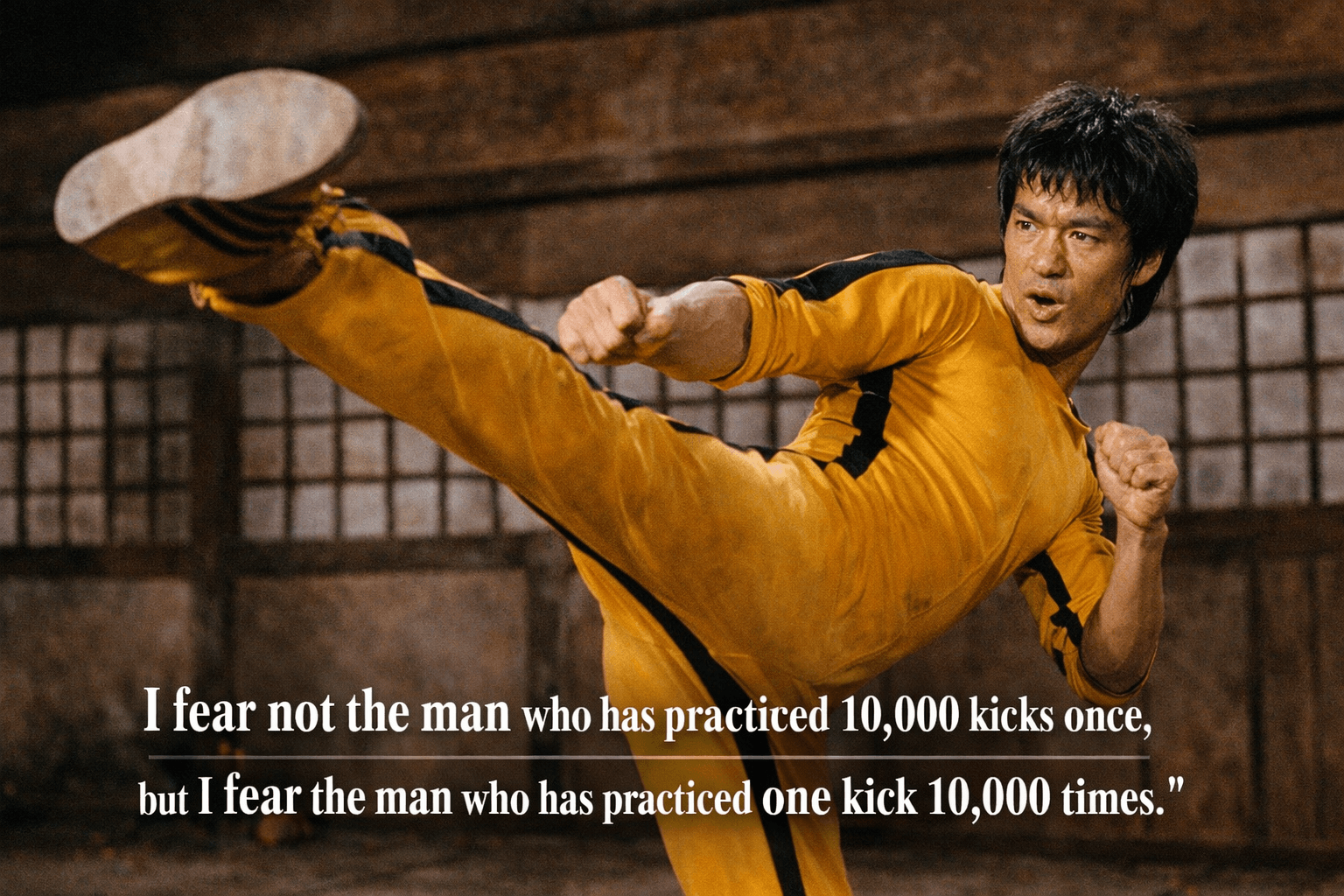
The well-known quote attributed to Bruce Lee captures that idea very well:
“I fear not the man who has practiced 10,000 kicks once, but I fear the man who has practiced one kick 10,000 times.”
The point is not that repeating the same thing automatically makes you an expert. The point is that useful repetition requires intent, correction, and purpose. In that same sense, Tiger Woods is often used as an example: the value of practice was not hitting balls for the sake of volume, but going into each session with a concrete goal. Practice for the sake of practice accumulates time. Practice with purpose builds performance.
Applied to cycling, the difference is huge. A threshold session is not valuable because it felt hard, but because it actually developed threshold. An endurance ride is not valuable because of how much elevation you accumulated, but because it built the aerobic base you were looking for without filling you with unnecessary fatigue. A strength block is not valuable because you left the gym destroyed, but because it produced the adaptation you were aiming for while still leaving you enough room to keep training well afterwards.
This is where a coach becomes key again, because they provide exactly what turns practice into deliberate practice: intent, judgement, correction, and continuity.
Having a Coach Is Also a Learning Process
People often talk about a coach only as a supervisor, planner, or load manager. But there is another equally important part: a coach also teaches. A coach teaches you how to interpret sensations, read data better, understand the purpose of each session, distinguish useful tiredness from poorly placed fatigue, and decide when to push and when to hold back. Over time, that learning changes the way you relate to training.
In fact, one of the best possible outcomes of a coaching process is that the athlete becomes more autonomous and more competent. Not because they no longer need support, but because they understand much better what they are doing and why they are doing it.
A clear example is cyclist B., who trained with me for a year and later made strong use of many of the concepts we had worked on during pre-season and in-season, especially in the area of gym work and strength training. The following year he had less time and decided to organise his training on his own, but he was no longer starting from zero: he was starting from what he had learned. And that too is part of a coach’s value. Not only improving your performance while you work together, but leaving you with tools that still serve you when your context changes.
Seen that way, having a coach is not only about delegating decisions. It is also about going through a guided learning process that gradually improves your own judgement as an athlete.
The Real Value of a Coach
The real value of a coach is not making you suffer more or filling your calendar with sessions. It is interpreting your case, making good decisions within a complex system, giving you useful feedback, ordering your priorities, and turning your practice into a process with intent. In short, it is about making sure your effort has direction.
Because improvement does not depend only on training a lot. It depends on training with purpose, adapting when context changes, and sustaining the process long enough for adaptations to happen. That is where a coach stops being someone who “sends workouts” and becomes what they really should be: an accelerator of learning and performance.
If you feel like you are putting in the hours but improving very little, struggling to break through the same ceiling, or making too many week-to-week decisions on the fly without a clear framework, maybe you do not need more motivation. Maybe you need better direction. And if you have decided to start working with a coach, you can contact me here.
Bibliography
[1] Randell AD, Cronin JB, Keogh JWL, Gill ND, Pedersen MC. Effect of instantaneous performance feedback during 6 weeks of velocity-based resistance training on sport-specific performance tests. J Strength Cond Res. 2011;25(1):87-93.
[2] Weakley J, Cowley N, Read DB, Timmins R, García-Ramos A, McGuckian TB, et al. The Effect of Feedback on Resistance Training Performance and Adaptations: A Systematic Review and Meta-analysis. Sports Med. 2023.
[3] Ericsson KA. Deliberate practice and acquisition of expert performance: a general overview. Acad Emerg Med. 2008;15(11):988-994.