Table of contents
- Milano-Sanremo 2026: the fairest race of the year
- A Monument decided in a very non-obvious way
- How the Sanremo finale really works
- Why this profile allows so many different winners
- Power profile comparison of the five main favourites
- What each favourite needs to win in 2026
- Final prediction for 2026
- Bibliography
Milano-Sanremo 2026: the fairest race of the year
Milano-Sanremo is the fairest race of the year. Not because it treats every rider equally, but because it is the great Classic that leaves more doors open to very different rider profiles than any other. A pure sprinter can win here if he survives, a Classics specialist with a sprint can win if he gets to the finish in a small group, a puncheur can win if he opens a gap on the Poggio, a strong rouleur can win by anticipating the finale with 1 or 2 km to go, and a climber with elite descending skills can win if he turns the finale into a race of precision.
Allowing for the obvious differences between sports, there is a useful parallel with athletics. A 200 m runner, a 1,500 m runner and a 10 km runner respond to very different physiological demands and, under normal conditions, they compete in separate events. Milano-Sanremo is a competitive anomaly: a race in which profiles comparable to those three worlds can all have a realistic path to victory. In athletics, a race like that simply does not exist.
And on top of that, this is a Monument. That means there are only five one-day races with this level of prestige. In terms of real importance, a clear editorial case can be made: after the Tour de France, Paris-Roubaix and the Tour of Flanders, Milano-Sanremo is probably the fourth most important race in the world because of its historical prestige, the quality of its field and its position in the calendar.
That is exactly what makes it so fascinating. It is not the hardest race on the calendar. It is the race with the greatest number of ways to be won.
A Monument decided in a very non-obvious way
The 2026 edition keeps the full essence of the race: 298 km from Pavia to Sanremo, with the classic sequence of the Capi, the Cipressa and the Poggio before the finish on Via Roma [1]. On the profile, the Cipressa looks like a gentle climb and the Poggio, taken in isolation, does not seem especially intimidating either. But reading Sanremo that way is not understanding Sanremo.
The race is not decided by the absolute severity of its gradients, but by the interaction of five factors: extreme duration, accumulated fatigue, positioning, repeated high-intensity efforts in the finale, and technical ability when everybody is already on the limit.
From a physiological point of view, Sanremo is not necessarily won by the rider with the best fresh 5-minute test. It is often won by the rider who best preserves his 1- to 5-minute performance after nearly 280 km, who tolerates fatigue better after repeated high-intensity efforts on the two key climbs, and who is still capable of accelerating above VO2max with incomplete recovery. In other words, durability and the ability to repeat hard efforts under fatigue matter enormously here [4][5].
After nearly seven hours of racing, a 4% climb stops being just a 4% climb. It becomes a filter of aerobic power, fatigue resistance, mechanical efficiency and tactical positioning. The winner is not the rider who can produce the most raw watts in a vacuum, but the one who reaches the decisive moment in the best condition and reads what the race actually demands at that point.
How the Sanremo finale really works
The decisive phase starts long before the final attack. You can view the full route profile here: see the race profile here. The Capi (Capo Mele, Capo Cervo and Capo Berta) do not usually decide the race, but they serve a very important role: they harden the terrain, raise the tension and force teams to start spending resources. Positioning already matters, the pace is already rising, and domestiques start disappearing.
Then comes the Cipressa, the first truly crucial point of the race with 28 km to go. It is 5.6 km at 4.1%, a climb gentle enough for many sprinters to keep dreaming, but demanding enough for a team like UAE to turn it into the first real breaking point if they choose to set a very high pace. The Cipressa does not always select through gradient. It selects through speed, tactical inertia and the impossibility of moving up if you are out of position. Because it is such a fast climb — last year Pogačar, Ganna and Van der Poel climbed it at around 37 km/h; you can see the segment here: see segment here — the drafting effect remains hugely important. On a gradient like that, aerodynamics still matter a great deal, and that is why a strong block can save its leaders a huge energetic cost until the precise moment that matters. My estimate is that, at those speeds, riding second or third wheel on that climb can represent an approximate saving of 10-20% compared with exposing yourself to the wind too early [3].
With 9 km to go, the Poggio begins. It is 3.7 km at just under 4%, with maximum ramps close to 8% and a road that narrows slightly, with hairpin bends in the early section. In fact, in those corners it is one of the few climbs in pro cycling where some riders briefly stop pedalling to take the line properly, precisely because of the speed at which it is climbed. That combination makes it a very particular ascent: it usually does not break riders through pure exhaustion, but through explosiveness, timing, speed and the violence of repeated pace changes. On the Poggio, isolated threshold matters less than the ability to launch or answer short accelerations far above average pace, with very little recovery between efforts. The Strava record here is 39.2 km/h, set in 2024; you can see the segment here: see segment here.
And then comes the section that makes Sanremo even more open: the descent. The Poggio descent is fast, technical, narrow in places and full of direction changes. A rider who crests with a 4-5 second advantage can turn that into a decisive gap. And a rider who descends better than the rest can win the race without necessarily having been the strongest on the climb. If you want to see how a race can be won on the Poggio descent, the clearest modern example is still Mohorič in 2022:
Video of Mohorič’s 2022 victory. Lanterne Rouge.
The final 2 km, already in Sanremo, are urban, long and fast. There is a left-hand bend at around 850 metres and the final major bend at 750 metres to go, before the finishing straight on Via Roma. That leaves room for two very different endings: a sprint or a perfectly measured move of anticipation.
Why this profile allows so many different winners
This is the key point of the article. Sanremo is the fairest race of the year because its route does not impose a single solution. Unlike other Monuments, it does not eliminate riders through one dominant trait. It filters through a combination of economy, punch, technique, aerobic capacity and fatigue resistance.
That is why it keeps so many riders alive so late into the race. A pure or near-pure sprinter can win if the pace on the Cipressa and Poggio does not completely blow the group apart and he reconnects on the descent. A Classics specialist with a sprint can win if he reaches the finish in a group of 5 to 20 riders. A puncheur can win if he opens a gap on the Poggio and crests with an advantage. An exceptional descender can win if he picks the exact second to commit on the descent. A strong rouleur can win if he attacks between the foot of the descent and the final kilometre, taking advantage of hesitation among the favourites. And, less common but still possible, even a breakaway can win if the race falls into a tactical loop like it did in 1982 [2].
That does not mean everyone has the same chances. It means something more interesting: very different rider profiles have a credible path to victory.
The table that best proves the thesis: podiums 2016-2025
| Year | 1st | 2nd | 3rd |
|---|---|---|---|
| 2016 | Arnaud Démare | Ben Swift | Jürgen Roelandts |
| 2017 | Michał Kwiatkowski | Peter Sagan | Julian Alaphilippe |
| 2018 | Vincenzo Nibali | Caleb Ewan | Arnaud Démare |
| 2019 | Julian Alaphilippe | Oliver Naesen | Michał Kwiatkowski |
| 2020 | Wout van Aert | Julian Alaphilippe | Michael Matthews |
| 2021 | Jasper Stuyven | Caleb Ewan | Wout van Aert |
| 2022 | Matej Mohorič | Anthony Turgis | Mathieu van der Poel |
| 2023 | Mathieu van der Poel | Filippo Ganna | Wout van Aert |
| 2024 | Jasper Philipsen | Michael Matthews | Tadej Pogačar |
| 2025 | Mathieu van der Poel | Filippo Ganna | Tadej Pogačar |
Just looking at this table already reveals the main idea. Although the Classics profile dominates the most recent podiums, the latest winners do not fit a single physiological pattern or a single tactical script. There are sprinters, puncheurs, Classics specialists, climbers with elite descending skills, rouleurs and hybrid riders who are impossible to fit neatly into one category.
What the recent winners tell us
Rather than analysing every name one by one, Sanremo is easier to understand by grouping its winners into families of rider.
The first group is the pure sprinter, represented above all by Arnaud Démare. His win is a reminder that this is still a race a fast man can win if he survives the selection and preserves his sprint after almost seven hours. Physiologically, that requires far more than just top speed: it requires limiting losses on the climbs, managing energy cost well and preserving neuromuscular freshness for the finish.
The second group is the sprinter with a Classics profile, where Jasper Philipsen and, to an extent, Wout van Aert fit very well. They do not need a completely flat race, but they do need a selection that is not definitive. They are riders who absorb fatigue better than a pure sprinter, sustain high output in 1- to 5-minute efforts and remain very fast with low glycogen and heavy legs.
The third group is the puncheur or fast climber, with Julian Alaphilippe as the clearest example. Sanremo can also reward the explosive Ardennes-style rider if the Poggio is raced like a war of accelerations rather than a simple sustained ramp-up in pace.
The fourth group is the Classics specialist, where Van der Poel and Van Aert belong. These are the riders who best fit a race that demands many things at once: positioning, punch, tactical reading, technical skill and a competitive sprint. They do not dominate only one phase of the finale. They are dangerous in almost all of them.
The fifth group is the all-rounder, with a profile closer to Michał Kwiatkowski and, in part, also to the most complete version of Van Aert. These are riders capable of performing in high mountains, in Classics and in reduced-group finishes. A complete rider with depth, tactical reading and few obvious weaknesses still has a lot of winning routes in Sanremo.
The sixth group is the Grand Tour climber, with Nibali as the clearest case. His victory showed that a great stage-race rider with depth, aerobic efficiency and the ability to read the exact moment can also win here, even if that is not, at first glance, the profile most closely associated with Sanremo — although Nibali is a special case because he is also a world-class descender.
And the seventh group is the specialist descender, with Mohorič as the perfect example. Perhaps not the strongest rider in absolute terms, but the one whose specific advantage — descending, tactical courage and precision on a technical section — is so great that it can be turned into victory.
That is the big conclusion from the recent palmarès: Sanremo not only accepts many types of winner. It also accepts many ways of winning.
The many ways to win Milano-Sanremo
- Reduced-group sprint. The most classic ending when the race is selective, but not selective enough for a solo winner.
- Relatively large-group sprint. Still possible if the Cipressa and Poggio are ridden very fast but without total demolition.
- Attack with 1-2 km to go. A powerful rouleur can exploit a second of hesitation and surprise everybody.
- Attack and escape on the Poggio descent. The Mohorič script. Very difficult, very technical, very real.
- Decisive attack on the Poggio. The most natural scenario for a puncheur or for a rider like Van der Poel or Pogačar if they manage to open a gap.
- Progressive attrition from the Cipressa. Less common as the final blow, but extremely important for blowing up the sprinters before the decisive moment and creating a small move that shapes the outcome of the race.
- Breakaway or tactical surprise. Very uncommon, but still possible precisely because the chase is not always well coordinated.
Power profile comparison of the five main favourites
Rather than talking about exact watts, it makes more sense to build a relative reading of each favourite’s profile. The chart below is not meant to be a lab test, but a visual way of understanding which scenario favours each rider. If you want to learn more about power profiling, you can read this other article: cycling performance benchmarks.
In this chart, 5-second sprint represents pure finishing speed; 60 seconds reflects the response to a violent pace change; 5 minutes represents the ability to launch or follow moves on the Poggio; 20 minutes reflects the ability to handle a very hard Cipressa; and fatigue resistance tries to show how much of that profile each rider still retains after 280 km. That is why this is not just a power chart: it is a chart of useful power at the end of Sanremo.
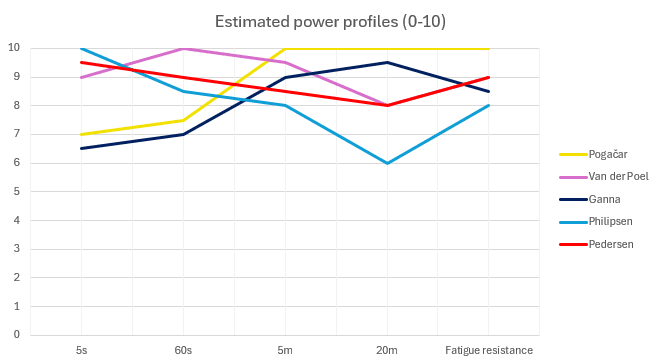
The chart is useful because it quickly shows where each rider is strong. Pogačar stands out clearly in 5- and 20-minute efforts and in fatigue resistance, which reinforces the idea that his best chance is to harden the race from a long way out and turn the Poggio into a real selection. Van der Poel appears as the most complete and balanced profile for solving almost any scenario: he has punch, short sprint and a very high level when the race is already fully switched on. Ganna stands out more for sustained power and for his ability to maintain very high speed when the group hesitates, which is extremely valuable if the finale turns into a chase. Philipsen shows the profile most clearly geared toward the finish, with huge value in short efforts but less room if the race really breaks apart on the climbs. Pedersen appears as a very solid rider almost across the board, especially dangerous when fatigue reduces the gap in pure top-end speed between the favourites.
Alongside the physiological profile, it is also important to assess descending skill and team strength. On the descent, the reference name is Van der Poel. Behind him would come, with different nuances, Mohorič as the absolute specialist if he enters the equation, and among the main favourites a fairly even group including Philipsen, Pedersen, Pogačar and Ganna. In tactical team terms, Alpecin start with the biggest advantage because they have two genuine winning cards, Van der Poel and Philipsen. I would then place UAE because of the depth of the block and the clarity of their race plan, with Ineos and Trek behind them as strong teams but with less room to dictate the outcome.
What each favourite needs to win in 2026
Tadej Pogačar
- Strengths: he is the best climber in the world and probably also the rider with the greatest capacity to sustain decisive efforts after many hours of racing. His real advantage is not only that he climbs better than anyone else, but that he preserves a very high percentage of his maximal aerobic capacity when the others have already lost some punch.
- Weaknesses: among the top favourites, he is one of the riders who least wants a tactical sprint against Van der Poel, Philipsen or Pedersen. And Sanremo demands something that does not always fit his instinct: stopping the work when it no longer suits him and forcing others to take on part of the burden.
- Tactics: he needs to make the Cipressa brutally hard to eliminate the sprinters and reach the Poggio with as few finishers as possible. His best scenario is a ferocious UAE lead-out, a sharp attack on the Poggio and a solo finish — or at least enough of a gap not to have to decide the race in a sprint.
Mathieu van der Poel
- Strengths: he is probably the most complete rider for this race. He combines 1- to 5-minute punch, sprint under fatigue, descending skill, positioning and the ability to answer repeated violent changes of pace. He has more routes to victory than anyone else.
- Weaknesses: his main limitation is not physical but tactical. If Philipsen makes the front group, Alpecin probably have the best possible duo for this finish, and that can force Van der Poel to work for his teammate rather than race for himself.
- Tactics: he can afford to follow Pogačar’s wheel without having to force the race from far out. He has three clear ways to win: attacking on the Poggio, attacking on the descent, or taking the sprint from a reduced group. His great strength is that he does not depend on a single script.
Filippo Ganna
- Strengths: he is one of the best time trialists in the group and one of the most dangerous riders if the race turns tactical and the lead group reaches the finale on the limit. His strength is not the most violent acceleration, but the ability to sustain very high speed when everyone else hesitates.
- Weaknesses: he does not have the same explosive ease as Pogačar or Van der Poel on the Poggio, and his final sprint is less reliable than that of Philipsen, Van der Poel or Pedersen. If the race is decided by pure acceleration or a clean sprint, he starts a step behind.
- Tactics: he needs to spend as little as possible, always arrive perfectly positioned, survive the Poggio without losing too much, and attack between the bottom of the descent and the final 2 km. His best scenario is turning the finale into a desperate chase, where his absolute engine matters more than everyone else’s top-end speed.
Jasper Philipsen
- Strengths: he is the best sprinter among the favourites. He is also not a fragile fast man: he handles fatigue very well, moves well in tense finales and preserves great finishing power after long efforts.
- Weaknesses: he depends more than others on surviving the selection. If UAE turn the Cipressa into a shredder and the Poggio is ridden at the absolute limit, his margin is narrower than that of Pogačar or Van der Poel. His challenge is not to attack better than everyone else, but to lose as little as possible before Via Roma.
- Tactics: he needs to spend the day hidden, burn as little energy as possible and arrive in a group. The bigger the front group, the better for him. And if Van der Poel is still there, Alpecin’s tactical value multiplies because they can play two winning cards at once.
Mads Pedersen
- Strengths: he is one of the most uncomfortable riders for all the favourites when the race gets hard without fully exploding. He has fatigue resistance, a very competitive sprint after long efforts, and a particularly solid level when the day turns hard, cold or generally unpleasant.
- Weaknesses: he may be a step behind Pogačar and Van der Poel on a climb like the Poggio. He also does not seem to have the most decisive team among the top favourites. If the race breaks completely at the highest level on the climb, his margin shrinks.
- Tactics: he needs a hard race, but not a totally destroyed one. His best chance is a sprint under fatigue from a reduced group of 6 to 15 riders, ideally with few domestiques left and several rivals already on the limit after the Poggio.
The surprise scenario that always exists in Sanremo
One of the reasons this race is so special is that even when everything seems to revolve around just a couple of names, there is almost always room for surprise.
The first surprise scenario is technical: an attack on the descent from Mohorič or Pidcock. It is not the most likely outcome, but Sanremo has already shown several times that a perfectly judged descent can be worth as much as the best attack uphill.
The second surprise scenario is a larger final group than expected, with more than ten riders and less control than anticipated. That opens the door to a sprinter or a fast Classics rider who is not the main betting favourite: Van Aert, De Lie, Kooij or any rider with a great sprint under fatigue and enough survival ability on the Cipressa and Poggio.
And the third surprise scenario, more subtle, is the rider who understands the race better than everyone else for thirty seconds. Sanremo heavily rewards that kind of intelligence applied at exactly the right moment. Stuyven already showed it. Mohorič did too. Ganna could do it. Even an outsider with less media focus could slip through if the big teams become tactically blocked. A very credible outsider in that case, beyond the top two or three favourites, would be Pidcock, who has already shown on several occasions that he can descend like very few others.
Final prediction for 2026
The logic of the race suggests that UAE will once again be the team with the greatest need to move the race from a long way out. If they want to maximise Pogačar’s chances, the Cipressa has to be much more than a prelude. It has to become a real first filter.
If that happens and the Poggio is reached with an already reduced and highly stressed group, Pogačar will have a great opportunity. But the problem remains the same: Van der Poel is there, probably the most complete rider for this specific finale. That is why a large part of Pogačar’s chances will depend on the work of his entire team. Cycling is a curious team sport in which only one rider wins.
If the race does not fully break apart, Philipsen and Pedersen are right in the fight. If it turns tactical and nervous, Ganna can turn his engine into a victory through anticipation. And if a moment of hesitation appears on the descent, Sanremo will once again remind everyone that here a race can be decided by legs, head and technique at the same time.
And that is exactly why it is so hard to dominate. In Sanremo, it is not enough to be the strongest. You have to be the right rider for those final fifteen minutes. In my opinion, there are only two races that can truly resist a great champion like Pogačar: Sanremo and Roubaix. We will be watching.
Bibliography
- [1] Milano-Sanremo. “Milano-Sanremo 2026: the route for the 117th edition has been revealed.” Official website. Link.
- [2] Cipressa, last pitfall before the inevitable. Link.
- [3] van Druenen, T., Blocken, B., Malizia, F., et al. “Aerodynamic analysis of uphill drafting in cycling.” Sports Engineering, 2021. Link.
- [4] Hunter, B., Spragg, J., Maunder, E., et al. “Durability as an index of endurance exercise performance.” 2025. Link.
- [5] Spragg, J., Maunder, E., et al. “The intensity rather than the quantity of prior work determines the amount by which the power-duration relationship is impacted.” 2024. Link.
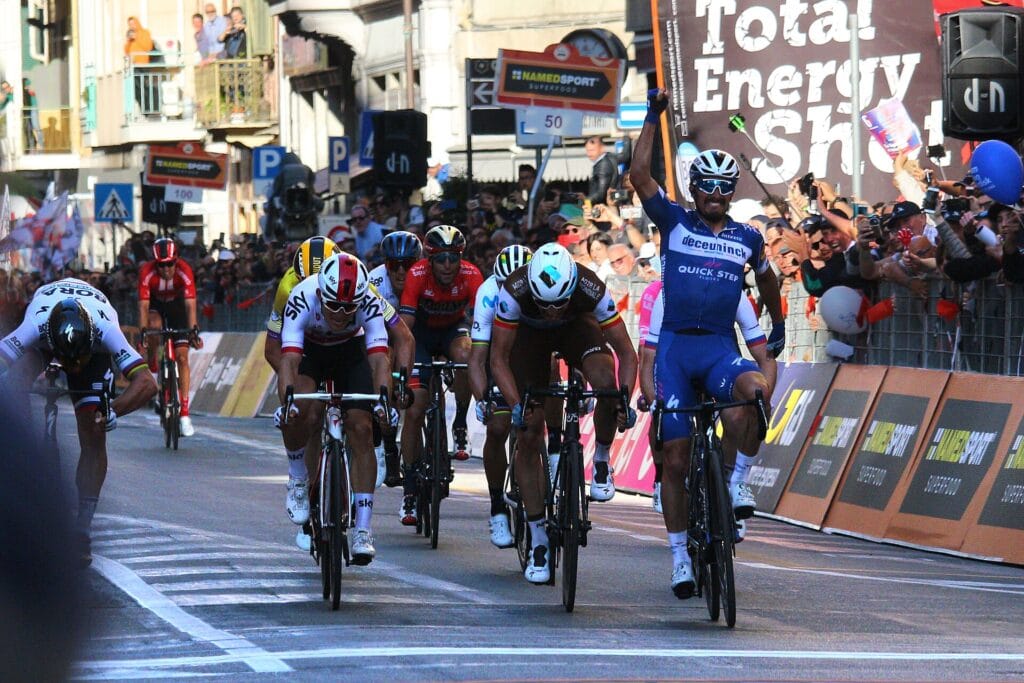
- Cover image: Claudio Martino, “2019 Milan-Sanremo”, Wikimedia Commons, CC BY-SA 4.0.